
Sep 20, 2026Materials & Customization
The Vegan Leather Market Is Heading Toward $27 Billion: What It Means for Bag Brands
The vegan leather market is heading toward $27B by 2033. Here is what bag brands should specify in PU leather before placing an order.
Quick answer: The global vegan leather market was valued at USD 11.08 billion in 2025 and is projected to reach USD 27.23 billion by 2033, a 10.7% compound annual growth rate (Verified Market Reports, 2026). Handbags sit inside the fashion and accessories segment that drives that growth. For bag brands, the practical consequence is a wider quality spread behind the same "vegan leather" label, which makes specs, not sourcing, the skill that decides whether a program ships well.
A buyer approves a PU swatch in July. The bulk order arrives in October with a flatter grain and a stiffer hand. Nothing on the purchase order says which tier of material was approved in July, so buyer and factory talk past each other. Market growth will not fix that gap. Written specs will.
What the market numbers actually say
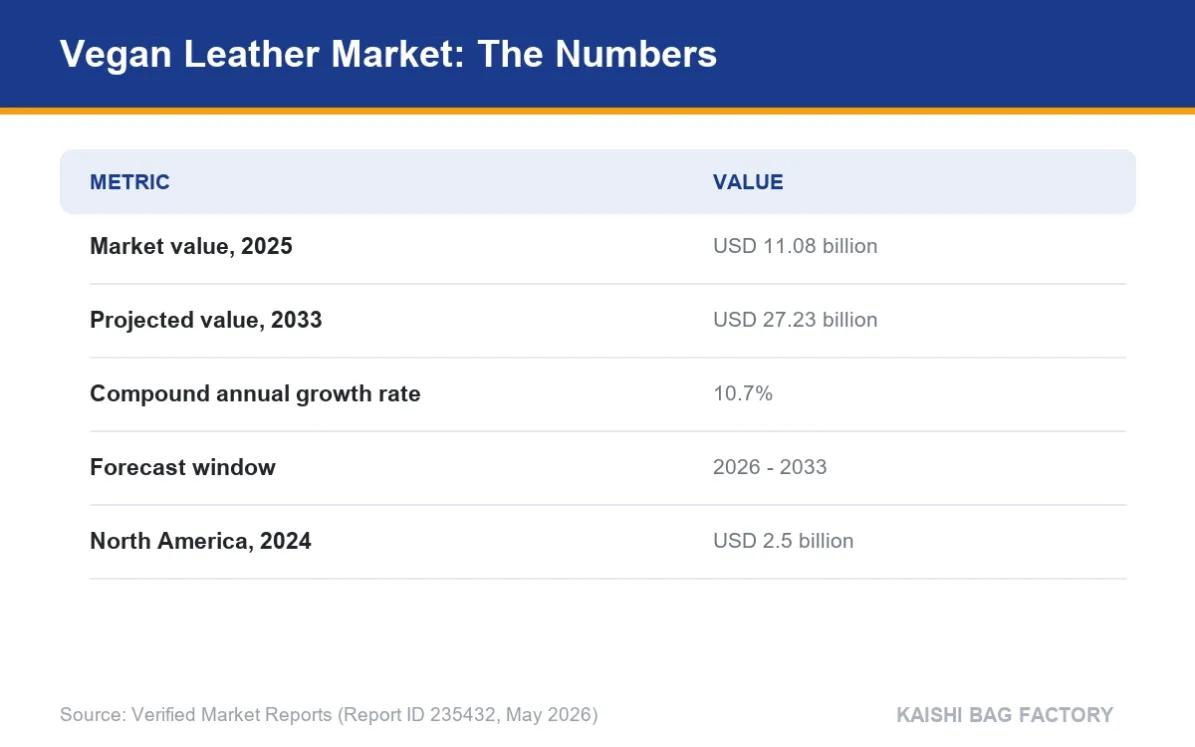
Verified Market Reports values the global vegan leather market at USD 11.08 billion in 2025 and projects USD 27.23 billion by 2033, a 10.7% compound annual growth rate over a 2026-2033 forecast window (Report ID 235432, updated May 2026). The same source puts North America at roughly USD 2.5 billion in 2024. Fashion and accessories, which covers handbags, wallets, belts and footwear, is among the areas named in the report.
Growth at that rate produces a supply response. More mills offer PU, more finishes reach the market, and more low-MOQ trial programs open up. It also widens the spread between the best and worst material sold at the same quoted price. We would rather brands stop treating "vegan leather" as a finished decision and treat it as a category that needs three written answers before any quote means anything.
Why "vegan leather" on a quote says less than you think
The term describes an absence rather than a specific material. It covers polyurethane coatings on knit or woven backing, PVC, microfiber suede and a growing list of bio-based materials. Two quotes can both read "vegan leather, 1.2mm" and still behave differently in the field, because total gauge and coating thickness are different numbers.
Here is where that gap shows up. A thin coating on a loose backing passes a desk review and then cracks along the fold lines of a strap within the first selling season. Buyers file this under factory quality. It is usually a gap in the brief, not a defect on the line.
If you are briefing a vegan leather tote program, put coating and backing in writing before anything else. It is the cheapest way to cut risk.
Three numbers that separate durable PU from disposable PU
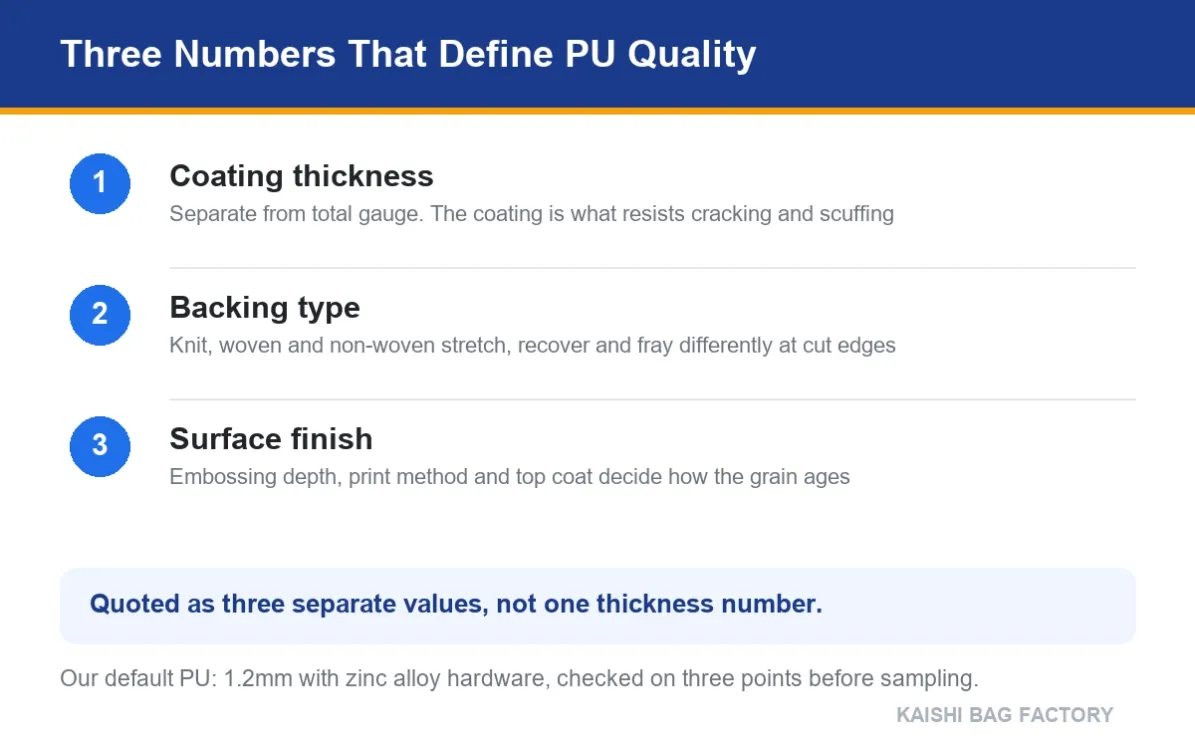
When we quote PU for a bag program, we quote it as three separate values. Buyers who collect the same three numbers from every supplier can compare quotes that would otherwise look identical.
- Coating thickness, separate from total gauge. A 1.2mm material can carry a thick or a thin PU layer, and the coating is what resists cracking and scuffing.
- Backing type. Knit, woven and non-woven backings stretch, recover and fray differently at cut edges, which changes how the material behaves on the line.
- Surface finish. Embossing depth, print method and top coat decide how the grain ages and how well the surface accepts debossing or printing.
Ask for test data on peel strength, flex resistance and rub fastness against the approved swatch, then keep a sealed sample. Our default material for vegan leather shoulder bags runs 1.2mm with zinc alloy hardware, and every PU we sample gets those three checks before it reaches a pattern table.
A brief your vegan leather supplier can quote against
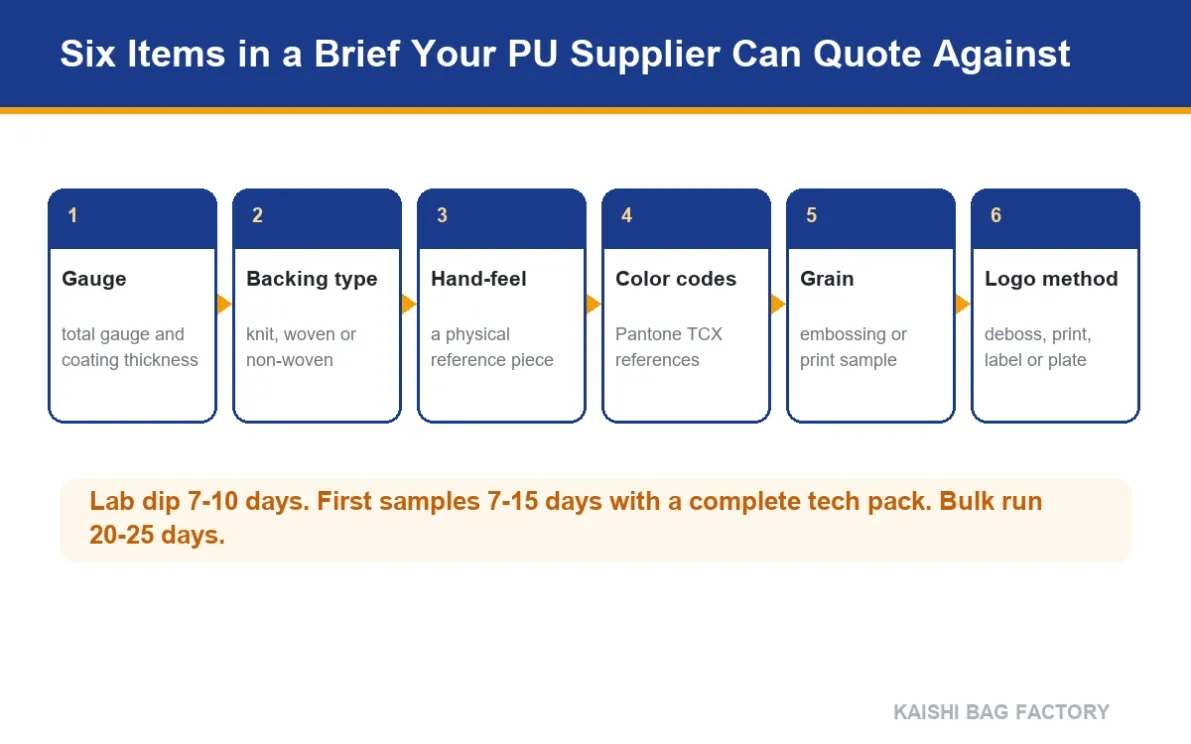
A usable brief carries six items: total gauge and coating thickness, backing type, a physical hand-feel reference, Pantone TCX color codes, an embossing or print reference, and how the logo will be applied. Add any test requirements your market demands on top.
Timing follows the brief. Lab dip runs 7 to 10 days in our workshop, and first samples typically take 7 to 15 days once the tech pack is complete. The bulk run takes 20 to 25 days after materials are in house, shipping FOB Tianjin as our usual term.
One mistake we see often: designs generated with AI tools sometimes specify fold lines or seams that the chosen material cannot carry at the specified thickness. Ask for a sewability review before sampling, not after the first round. It costs a day and saves a revision.
How we grade PU on our floor
Before a PU enters sampling at Kaishi Bag Factory, we check three things: gauge consistency across the roll, grain depth against the reference swatch, and a fold test at the point where the strap meets the body. A material that fails the fold test does not get downgraded. It gets rejected, because that point is where surface failure turns into a customer return.
Our stated baseline for vegan leather programs is 300 pieces per style with mixed-item orders accepted, and we quote PU as a three-part spec: backing, coating, finish. A single thickness number hides where the durability lives.
By buyer type: what the growth actually changes for you
- Brand founder launching a first range · Do this first: Order physical swatches in two or three tiers before design freeze · Why: Photos and PDFs hide coating differences
- Importer comparing supplier quotes · Do this first: Require gauge, backing and coating in writing on every quote · Why: The same price can hide a material downgrade
- Wholesaler running repeat orders · Do this first: Keep a sealed approved swatch per style with your factory · Why: Protects the second and third runs
- Promotional buyer under budget pressure · Do this first: Keep canvas for volume tiers and reserve PU for premium items · Why: Material cost against perceived value
- Amazon seller with return exposure · Do this first: Specify peel and flex tests and keep the reports · Why: Surface failure drives most PU returns
One note for wholesalers comparing across shoulder bag lines and crossbody styles: the same three numbers apply, so one approved spec per material family can cover a whole catalog.
FAQ
Is vegan leather the same as PU leather?
PU is the most common vegan leather on the market, but the term also covers PVC, microfiber suede and plant-based materials. Ask which one a quote refers to before comparing prices.
How do I check vegan leather quality before ordering?
Compare physical swatches at the same gauge, then request peel, flex and rub test results. A photo cannot show coating thickness, and a spec sheet alone does not prove the coating.
What MOQ applies to custom vegan leather bags?
It depends more on the finish than the material. Our baseline is 300 pieces per style with mixed orders accepted; custom embossing or a custom color can raise that number.
Does vegan leather last as long as animal leather?
Longevity depends on coating and backing quality rather than the material category. A well-specced PU holds up over years of daily use; a thin coating on a loose backing can fail within one season.
What certificates should I ask for?
Start with material test reports for the PU itself. A certificate covers one specific claim, such as recycled content, so match each one to the claim instead of treating it as proof of quality.
Next step
Before design freeze, collect three values in writing for every PU you plan to use: coating thickness, backing type and surface finish. Then keep a sealed swatch of the approved material with your factory and one in your own office.
At Kaishi Bag Factory we manufacture vegan leather totes, shoulder bags and 3-piece sets in Baigou, and we quote PU as a three-part spec by default. Send your material requirements through our contact page and we will reply with swatch options and a sampling plan.