
Sep 17, 2026Sourcing & Importing
US Tariffs on Chinese Bags in 2026: How to Calculate Your True Landed Cost
What US tariffs really apply to Chinese bags in 2026: MFN base rates, Section 301, the July forced-labor action, and a line-by-line landed cost example.
Your quote says $4.50 per bag, FOB Tianjin. By the time the cartons reach your warehouse, the same bag costs closer to $7.50 — and most of that gap is duty, not freight. The numbers below are illustrative, but the tariff layers behind them are real, current as of September 2026, and they catch a lot of first-time importers by surprise.
US tariffs on chinese bags stack in layers: a base rate set by the bag's material, a 25% Section 301 duty that has applied to most Chinese bag lines for years, and a newer forced-labor action from July 2026 that comes with a cap most trade summaries get wrong. This guide walks each layer, then runs a line-by-line landed cost calculation you can copy for your own quotes.
US tariffs on Chinese bags: the stack, line by line
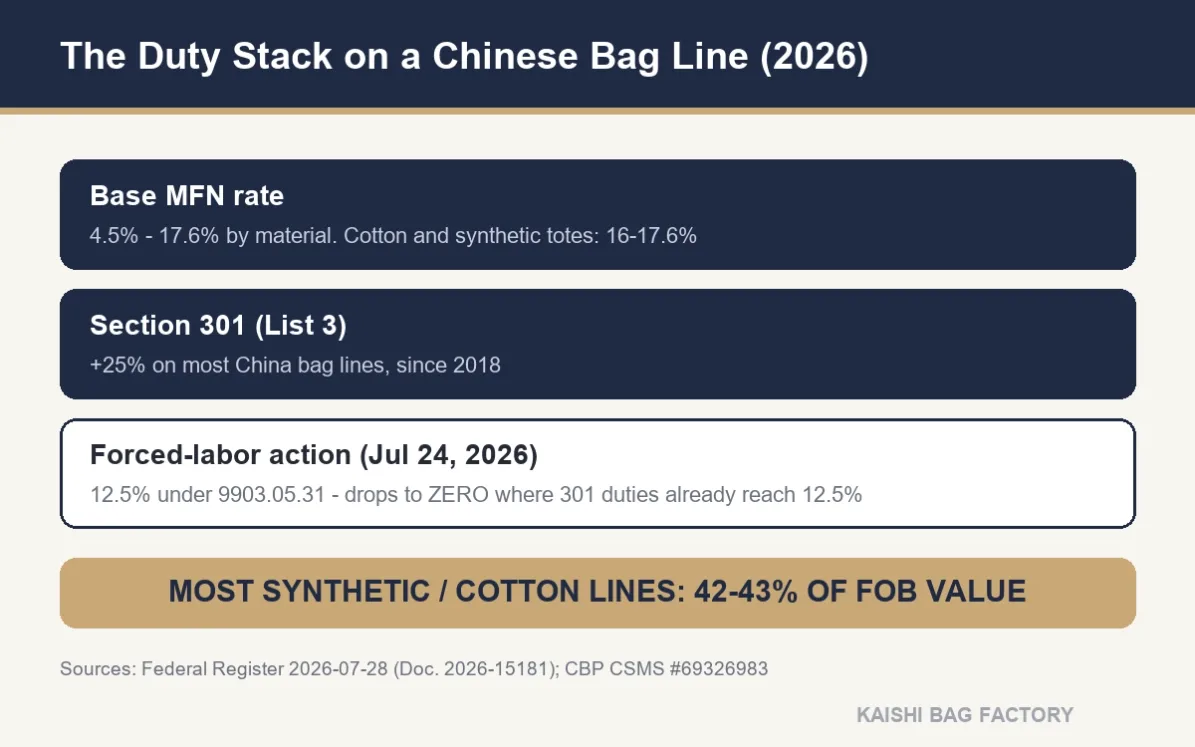
Every bag enters the US under HTS heading 4202, and three separate layers apply to China-origin goods:
- Base MFN rate: 4.5% to 17.6%, set by material. Leather handbags (4202.21) sit near 5.7%. Synthetic and cotton tote and travel bags run much higher: cotton travel and shopping bags under 4202.92.31 carry 17.6%. The outer-surface material decides the line, which is why your fabric spec matters before you even ask for a quote.
- Section 301: +25% for most Chinese bag lines. The technology-transfer Section 301 action (List 3) has covered bags since 2018. This is the layer that doubles many buyers' expected duty bill.
- The July 2026 forced-labor action: 12.5%, with a cap. Effective July 24, 2026, USTR imposed an additional 12.5% ad valorem duty on Chinese goods under HTS 9903.05.31. Here is the part many summaries miss: under the Federal Register notice, where existing Section 301 duties for an economy already reach 12.5%, the new forced-labor rate drops to zero. Since most bag lines already carry the 25% List 3 duty, the cap absorbs the new action for them; your customs entry, not a trade blog, shows the applied rate.
Add layers one and two and most synthetic or cotton bag lines land near 42–43% of FOB value, before freight. Verify your exact line at hts.usitc.gov, and confirm the applied rate with your customs broker. Rates in this space have changed twice this year.
Landed cost is five numbers, not one
FOB price is where the calculation starts, not where it ends. Landed cost per unit:
- FOB unit price: the factory quote, goods loaded at the Chinese port
- Duty: FOB value multiplied by your combined rate
- International freight: ocean or air, per unit
- Insurance: optional but cheap relative to the exposure
- Clearance and entry fees: brokerage, port fees, documentation
Duty is calculated on FOB value, so every dollar negotiated off the factory price also shrinks the duty base. Freight, by contrast, is quoted per container or per cubic meter and only divides across your units.
Why your HTS subheading moves the rate
Two bags of identical size can carry different duty rates because heading 4202 splits by outer-surface material and use:
- 4202.21: handbags with leather outer surface, base near 5.7%
- 4202.22: handbags with plastic or textile outer surface, base near 16–17.6%
- 4202.92: travel, sports and shopping bags, textile surface, base up to 17.6%
A canvas tote and a PU leather tote can therefore differ by more than ten points at the base layer alone. The factory's job is to give you an accurate material spec (outer-surface composition, lining, hardware) that supports the right classification. The classification call itself belongs to your customs broker. When we quote a custom canvas tote program, we send the spec sheet in the format brokers ask for, because a spec that supports the correct subheading is worth more than another cent off the price.
A worked example, line by line
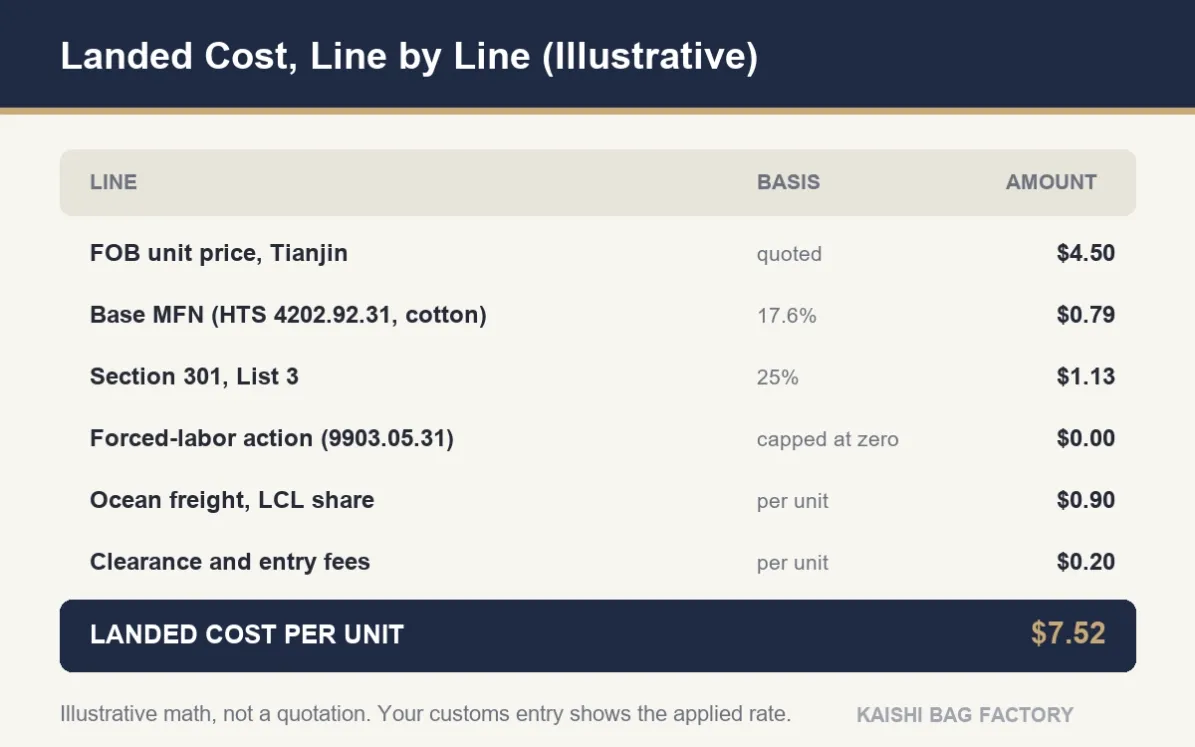
Illustrative math — not a quotation — for 500 canvas totes, FOB Tianjin:
- FOB unit price · Basis: quoted · Amount: $4.50
- Base MFN (4202.92.31, cotton) · Basis: 17.6% × $4.50 · Amount: $0.79
- Section 301 (List 3) · Basis: 25% × $4.50 · Amount: $1.13
- Forced-labor action (9903.05.31) · Basis: capped at zero · Amount: $0.00
- Ocean freight (LCL share) · Basis: per unit · Amount: $0.90
- Clearance and entry fees · Basis: per unit · Amount: $0.20
- Landed cost per unit · Amount: ≈ $7.52
Two habits make this number trustworthy. First, ask the factory to show the FOB price and port separately from freight; a quote that blends them hides the duty base. Second, ask your broker to confirm the subheading and the applied 9903 headings before you wire the deposit, because the forced-labor cap depends on your exact line.
Payment timing, deposits and rate-change risk
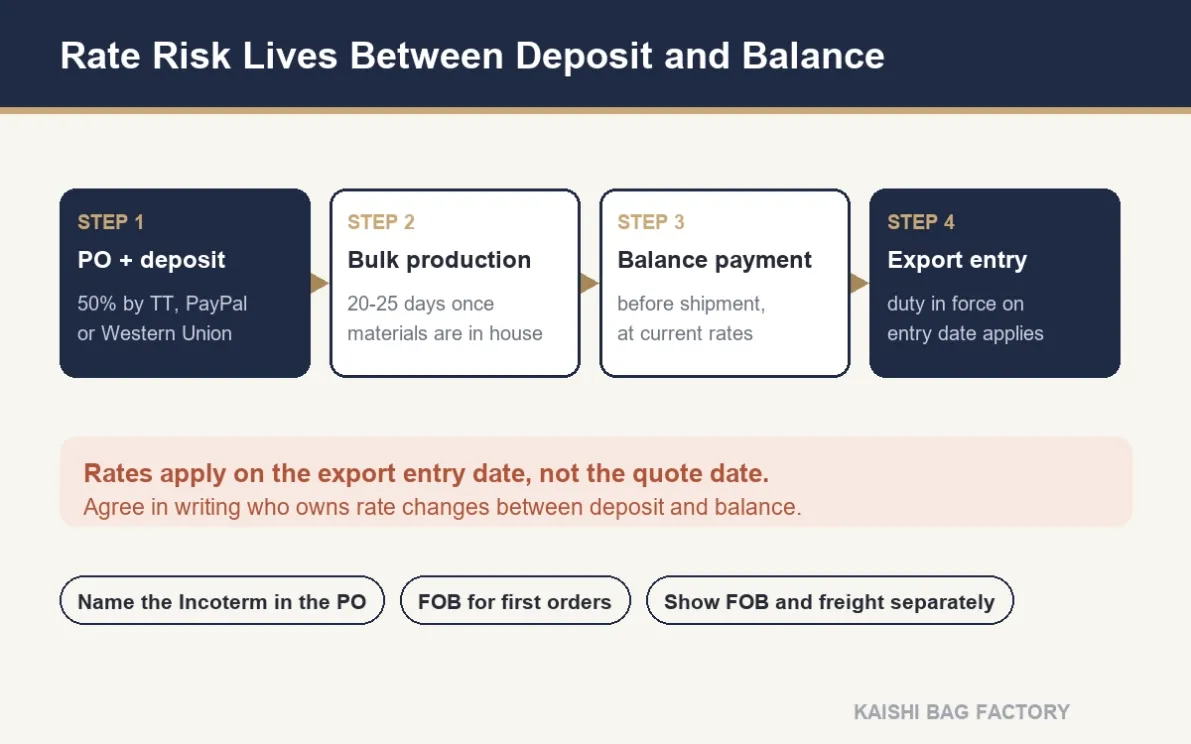
The duty rate that applies is the one in force on the date of export entry — not the date you requested the quote, and not the date you paid the deposit. That gap is where cash planning matters:
- Our standard terms are a 50% deposit by TT, PayPal or Western Union, with the balance before shipment.
- Bulk production runs 20–25 days once materials are in house, so a bag ordered today ships into a tariff environment five weeks away.
- Rate changes mid-order hit your balance payment, not your deposit.
This is why the Incoterm and the rate-change risk belong in writing. Don't book your first order on EXW terms. We see it regularly: a buyer takes our EXW price, then expects the factory to manage inland transport and ocean freight, and when the freight market moves between deposit and balance, the dispute lands with us. EXW can suit buyers with their own forwarder in China. For a first order, FOB from a named Chinese port keeps the duty base clean and puts freight under your control.
China+1 will not dodge the forced-labor action
The July 2026 action covers around 60 economies, not only China. Vietnam draws the same 12.5% forced-labor rate, Malaysia 10%. Moving a tote program from Baigou to Ho Chi Minh City to escape this specific layer is arithmetic that fails on arrival — and the cap logic above applies differently in every country, which makes side-by-side comparisons harder, not easier.
Diversify your supply chain for resilience, capacity and bargaining power if those reasons fit your business. Do not do it on the assumption that tariffs are a China-only cost in 2026.
What to put in writing before you pay the deposit
Five items prevent most tariff-related disputes we have seen:
- FOB unit price and the named port, stated separately from freight.
- A material spec detailed enough to support HTS classification, starting with outer-surface composition.
- The Incoterm, named in the purchase order, not just the quotation.
- Who owns the risk if the duty rate changes between deposit and balance.
- A commercial invoice that shows duty-relevant values clearly, so your broker files without guessing.
A vegan leather tote and a cotton canvas tote with the same dimensions can classify differently, so item two is where the money is.
FAQ
What is the total tariff rate on bags from China in 2026?
For most synthetic and cotton bag lines it is roughly 42–43% of FOB value as of September 2026: a 16–17.6% MFN base plus the 25% Section 301 duty, with the July forced-labor action capped at zero where Section 301 duties already reach 12.5%. Leather handbag lines run lower. Confirm your subheading at hts.usitc.gov.
Who pays US import duties, the buyer or the Chinese factory?
The importer of record pays, which is normally the buyer. Under DDP terms the seller takes the goods to your door duties paid, but that cost is priced into the quote; under FOB you pay duty through your own broker at entry.
Does the 12.5% forced-labor duty stack on top of Section 301?
Not for most Chinese bag lines. The Federal Register notice caps the new rate at zero where existing Section 301 duties already reach 12.5%, and bags on List 3 already carry 25%. Lines below the threshold get topped up. Your customs entry shows the applied rate.
How do I calculate landed cost per unit?
Add FOB unit price, duty (FOB value times your combined rate), freight per unit, insurance and clearance fees. Duty is always computed on the FOB value, which is why the FOB price and the material spec both matter.
Do I need supply-chain documents for the forced-labor duty?
The July 2026 action is a blanket country duty, so it applies without per-shipment evidence. Documentation still matters for HTS classification and for any separate forced-labor enforcement on specific supply chains, so keep material specs and sourcing records current.
Next step
Before you pay a deposit, get three numbers in writing: the FOB unit price with the named port, the material spec that supports your HTS line, and the Incoterm that assigns rate-change risk. Then run the table above with your own quantities.
At Kaishi Bag Factory we produce canvas, PU and vegan leather totes, hobo bags and 3-piece sets in Baigou with a 300-piece baseline per style, mixed-item orders accepted, shipping FOB Tianjin. Send your spec, quantity and destination market through our contact page, and we will quote with the material detail your broker needs.