Custom Printing, Labels and Hardware: A Private Label Prep List
Private label bag buyer checklist: approve artwork, measured logo placement, label wording, material-compatible branding and a production-intent sample before bulk.
Quick answer: prepare five approval files
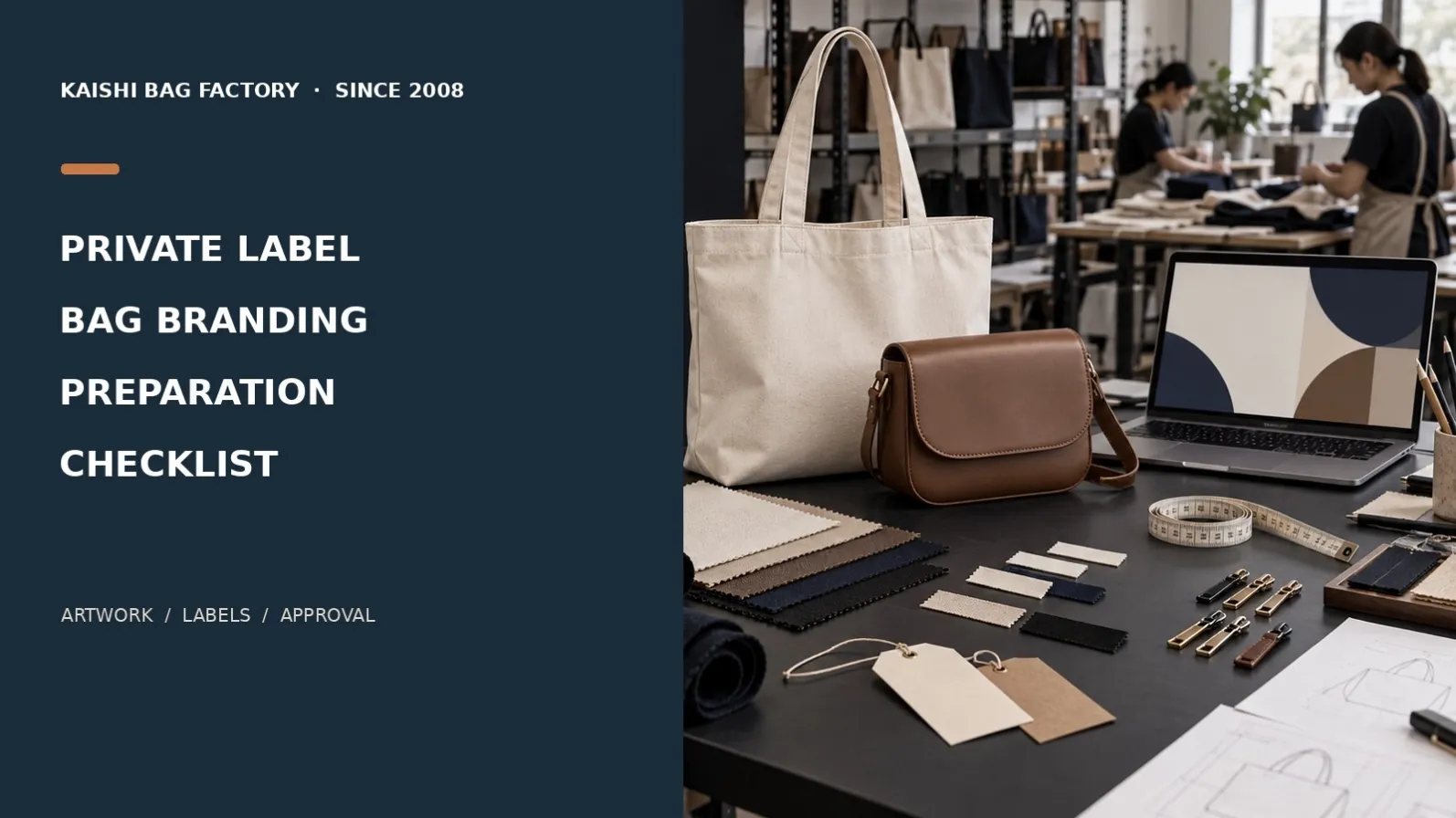
Before requesting a private label bag quote, send authorized artwork, measured placement, a preferred branding method, a destination-specific label-content brief and an approval plan. Ask the factory to test the chosen method on the actual material and show it on a production-intent bag. A mockup alone cannot confirm legibility, attachment, colour or durability. Keep a dated sample and a written change log before bulk production.
This checklist is for brand owners and importers developing original OEM/ODM bags. Kaishi Bag Factory, based in Baigou, China, has worked on custom bags since 2008. The material, design and quantity determine which branding methods are feasible; a quoted option is confirmed only after review and sampling.
1. Supply artwork you have permission to use
Provide a source vector file when possible, plus an approved visual proof showing the logo's proportions, colours and clear space. State who owns the artwork and whether the factory may share it with a component supplier solely for the project. Do not ask a factory to reproduce a third-party logo or a protected design without the rights holder's authorization. An NDA may be discussed when needed, but its scope and signatures must be agreed rather than assumed. See our brand confidentiality guide for project discussion.
A high-resolution raster file can work for some printing methods, while a vector source or a redrawn technical file may be required for tooling, embroidery digitization or tiny woven details. The method and supplier determine the exact file format. If only a screenshot is available, request an artwork-preparation quote before approving production.
2. Specify placement with measurements
Mark a named reference point on a bag drawing: for example, the seam at the top of the front panel. Give logo width and height, horizontal alignment and measured distance from that point. Note whether the artwork must remain centered when the bag is filled or folded. Repeat for an inside label, side tab, hang tag and branded component. A photo marked “roughly here” leaves too much room for inconsistent placement.
| Brand element | Brief should include | Sample approval check |
|---|---|---|
| Front artwork | Method, size, position, colours | Edges, legibility, alignment |
| Woven or printed label | Exact text, dimensions, seam placement | Small text, attachment, loose threads |
| Hardware mark | Component drawing, finish, tooling ownership | Fit and operation on the assembled bag |
| Packout | Hang tag, barcode or outer label content | Version, quantity and destination match |
3. Match the branding method to the material
Screen printing may suit a flat fabric panel and limited colours. Transfer or digital methods may suit detailed artwork, subject to material and finish trials. Embroidery has stitch-density and small-letter limitations and can change the hand of a light fabric. Debossing or embossing needs a suitable material, die and trial to verify the result; it is not a universal option for every PU or leather surface. Woven labels need enough size for legible text. Metal plates and custom zipper pulls can require tooling and a supplier minimum. These are options to evaluate, not standing promises that every method or material is stocked.
Compare one or two sampled options on the intended bag material. Look at colour match under consistent lighting, distortion on curved panels, abrasion at contact points, legibility and adhesion or attachment. Discuss any relevant test method and acceptance criteria with the buyer and printer. Do not claim a print is “permanent” or a label “eco-friendly” without product-specific evidence.
4. Separate branding from mandatory market information
The brand label, care information, fibre composition, country-of-origin marking, product identifier and economic-operator details serve different purposes. Their requirements depend on the product, material and destination market. The importer or brand should confirm the applicable rule and provide approved wording and placement before labels are produced. A factory should not guess a universal label set.
For the United States, CBP's handbag origin-marking ruling illustrates how conspicuousness is assessed for a specific bag, while the FTC Textile Products Identification Act contains exemptions for certain textile products incorporated into handbags and luggage. Neither source means every bag is exempt from origin marking or that all bags need apparel-style care and fibre labels. For EU sales, review the European Commission's product-safety guidance and the actual product scope. Have a qualified market specialist confirm the exact information required for your item and sales channel.
5. Approve a production-intent branding sample
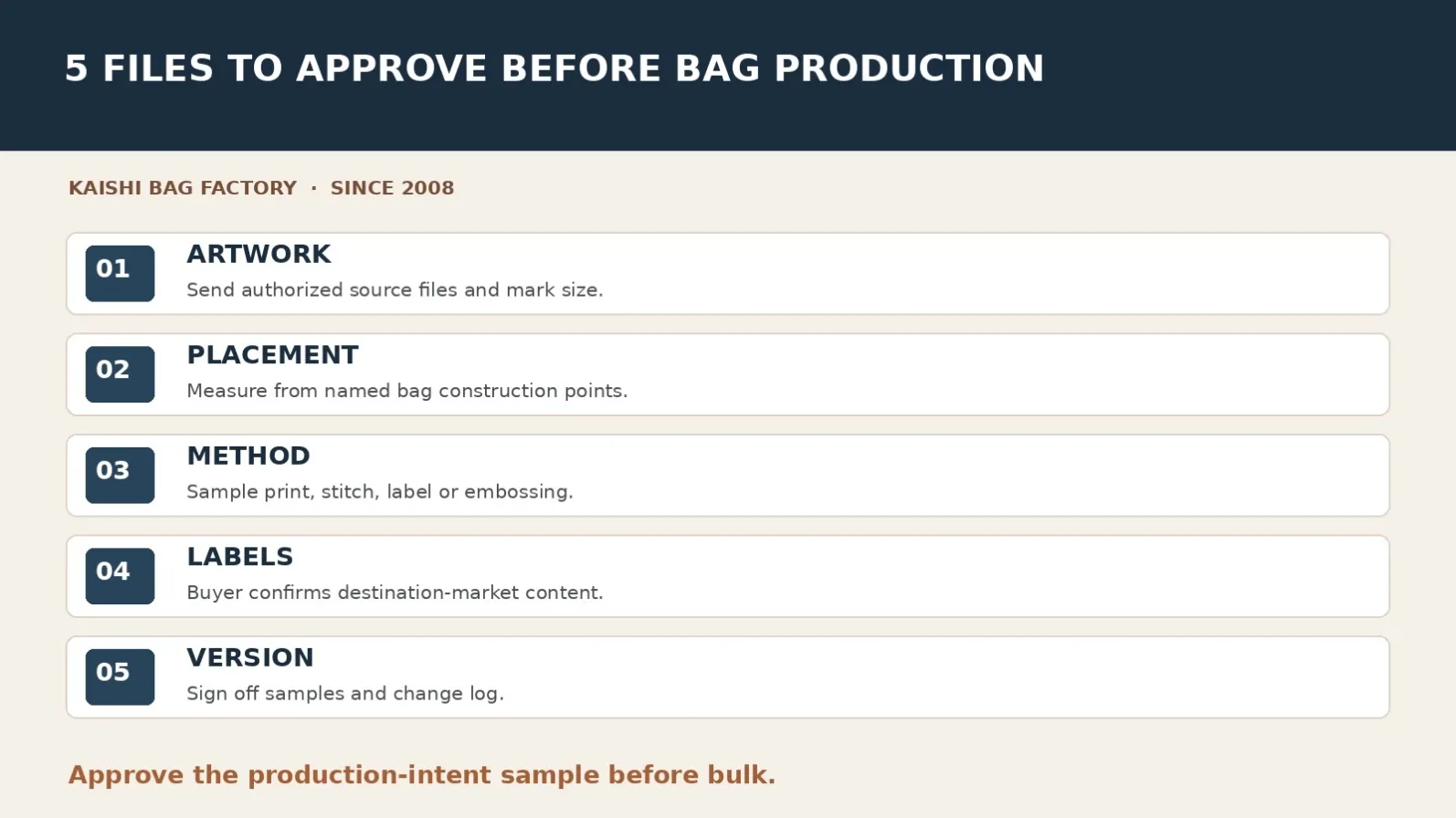
- Compare all visible artwork with the approved source and physical colour reference.
- Measure placement on the assembled bag rather than only on a flat panel.
- Read each label and hang tag, checking spelling, destination-specific content and product version.
- Inspect printing edges, embroidery backing, label seams and any hardware mark.
- Record which sample version and component references are approved and who authorized changes.
A revised artwork, colour, material, bag construction or label wording may require a new proof or sample. Approve the final version before bulk. This protects the brand and makes inspection criteria reproducible.
Budget and timing questions
Artwork preparation, screens, dies, weaving, embroidery digitization and custom hardware can create separate costs or minimum purchases. Quote them explicitly, along with the unit price, sample fee and any required approval rounds. Kaishi's standard MOQ is usually 300 pieces per style. A 200-piece first order may be assessed case by case without guarantee; 100 pieces is generally not feasible. Samples are paid in advance. Payment is by T/T only, typically 50% deposit and 50% before shipment. Lead time depends on design, selected materials, artwork and sample approval, component availability and quantity.
Frequently asked questions
Can I send only a logo screenshot?
It can show the idea, but production may need a source file or redraw. Ask for artwork preparation before approving cost and method.
Is vector artwork required for every print?
No universal rule applies. The method and supplier determine requirements. Vector files are a useful starting point for scalable marks and tooling.
Can the factory use a reference bag's brand logo?
Only with authorization from the rights holder. Send an original design or proof of permission.
Are care and fibre labels compulsory on every handbag?
No single answer applies across materials and markets. The brand or importer should check the applicable rule and approve the content.
Does a custom zipper pull require tooling?
It may. Shape, marking method, supplier and quantity determine feasibility, costs and timing.
When should label wording be finalized?
Before producing labels and before final sample approval; late text changes can require replacement components.
Can a 200-piece first order be considered?
Possibly on a case-by-case basis, but it is not a standing offer. The usual MOQ is 300 pieces per style.
Sources and next step
- US CBP handbag origin-marking ruling
- US FTC Textile Products Identification Act
- European Commission product-safety overview
Send your original bag drawing, authorized logo artwork, destination market, quantity and desired label positions through the Kaishi contact page. We can review a feasible branding route and sample plan.