
MOQ, Sampling and Lead Time Explained for Custom Bag Buyers
Plan a custom bag order with confirmed MOQ, sample scope, approval gates and timing assumptions. Kaishi usually requires 300 pieces per style.
Quick answer: confirm quantity, sample scope and the schedule together
Kaishi Bag Factory's standard MOQ is usually 300 pieces per style. A first order of 200 pieces may be evaluated individually, without a guarantee; 100 pieces is generally not feasible. Sampling and production timing depend on the approved design, materials, sample confirmation and quantity. A useful quotation states the quantity breakdown, sample scope, charges, approvals and schedule assumptions together, rather than treating MOQ and lead time as independent promises.
This guide helps brand owners and wholesale buyers prepare an order-planning brief. It is not a promise of lower minimums, free samples or fixed delivery dates. Kaishi is based in Baigou, China and has worked on OEM/ODM bags since 2008. For a first project, the goal is to establish what can be confirmed before you commit to inventory and a launch date.
What does MOQ per style mean?
A style is a defined bag design with an agreed construction and specification. Different designs should not automatically be combined into one minimum. Colour allocations, material choices and custom components may introduce separate purchasing constraints. Ask Donna to confirm the breakdown for the actual project instead of assuming that every colour combination is acceptable.
For example, if you are considering several colourways of one design, send the proposed quantity for each colour. This gives the factory enough information to assess material sourcing and production. Do not describe a total order quantity without its allocation, and do not promise your sales team an assortment before it is confirmed.
MOQ is a supplier and project condition, not an industry-wide fixed number. Material purchases, pattern preparation, cutting, machine setup and component requirements can affect feasibility. A simpler design can be easier to assess, but simplicity alone does not guarantee an exception to Kaishi's usual minimum.
How to request a 200-piece first-order assessment
State clearly that you are asking for an assessment, not applying a published small-order entitlement. Include the bag drawings, dimensions, intended material, logo method, colour breakdown and destination market. If you can accept an alternative material or component, explain which features are essential and which are flexible.
Donna can then evaluate whether a 200-piece first order is practical for that specification. Availability, commercial terms and feasibility must be confirmed for the individual order. A higher unit-price budget does not ensure approval, and a forecast of future reorders does not reduce the current minimum automatically.
- Keep one clear specification version for the assessment.
- Identify mandatory features and acceptable alternatives.
- Give quantities by style and colour, not only an overall total.
- Share your target market, budget and target arrival window.
- Wait for written confirmation before making a retail commitment.
If the assessed quantity is not feasible, revise the assortment, scope or launch plan. Avoid treating an unconfirmed stock material as guaranteed available or combining unrelated styles to manufacture an apparent minimum. A realistic first order should fit both the production constraints and your inventory budget.
Agree what the sample is intended to prove
A physical sample can help you assess dimensions, shape, pockets, straps, closures, branding placement and workmanship. Its purpose should be stated in the brief. A development sample used to explore shape is not automatically the final production reference if the material or hardware will change.
Before development, confirm the proposed materials and any substitutions. If a temporary component is used, identify what remains to be approved. Ask for the sample fee, included work, revision scope and shipping charges. Samples are paid upfront and the fee is non-refundable; do not assume a free sample or automatic deduction from a later bulk order.
Use a dated feedback sheet that separates required corrections from optional design changes. Include measurements and marked photographs where helpful. Consolidate comments from purchasing, design and quality teams before sending them, so conflicting instructions do not produce avoidable rounds of work. For detailed sample feedback, use the bag sampling guide.
Read the quotation as a connected set of conditions
| Item | Confirm in writing | Do not assume |
|---|---|---|
| Quantity | Style and colour breakdown; accepted minimum for this project. | Mixed designs automatically qualify together. |
| Sample | Brief, materials, charges, revision scope and approval purpose. | Free sampling or automatic fee credit. |
| Bulk specification | Approved sample, dimensions, components, branding and packaging. | Later substitutions need no approval. |
| Schedule | Start conditions, goods-ready estimate and dependencies. | A deposit alone starts a fixed delivery countdown. |
| Payment | T/T; normally 50% deposit and 50% before shipment. | Balance after arrival or alternative payment methods. |
Compare supplier quotations only after aligning those items. Two prices can describe different materials, quantities or packaging. Ask which costs are separate, including sample development or tooling where applicable. Record the quote currency and validity rather than assuming that every later revision retains the original price.
Distinguish development, production and delivery
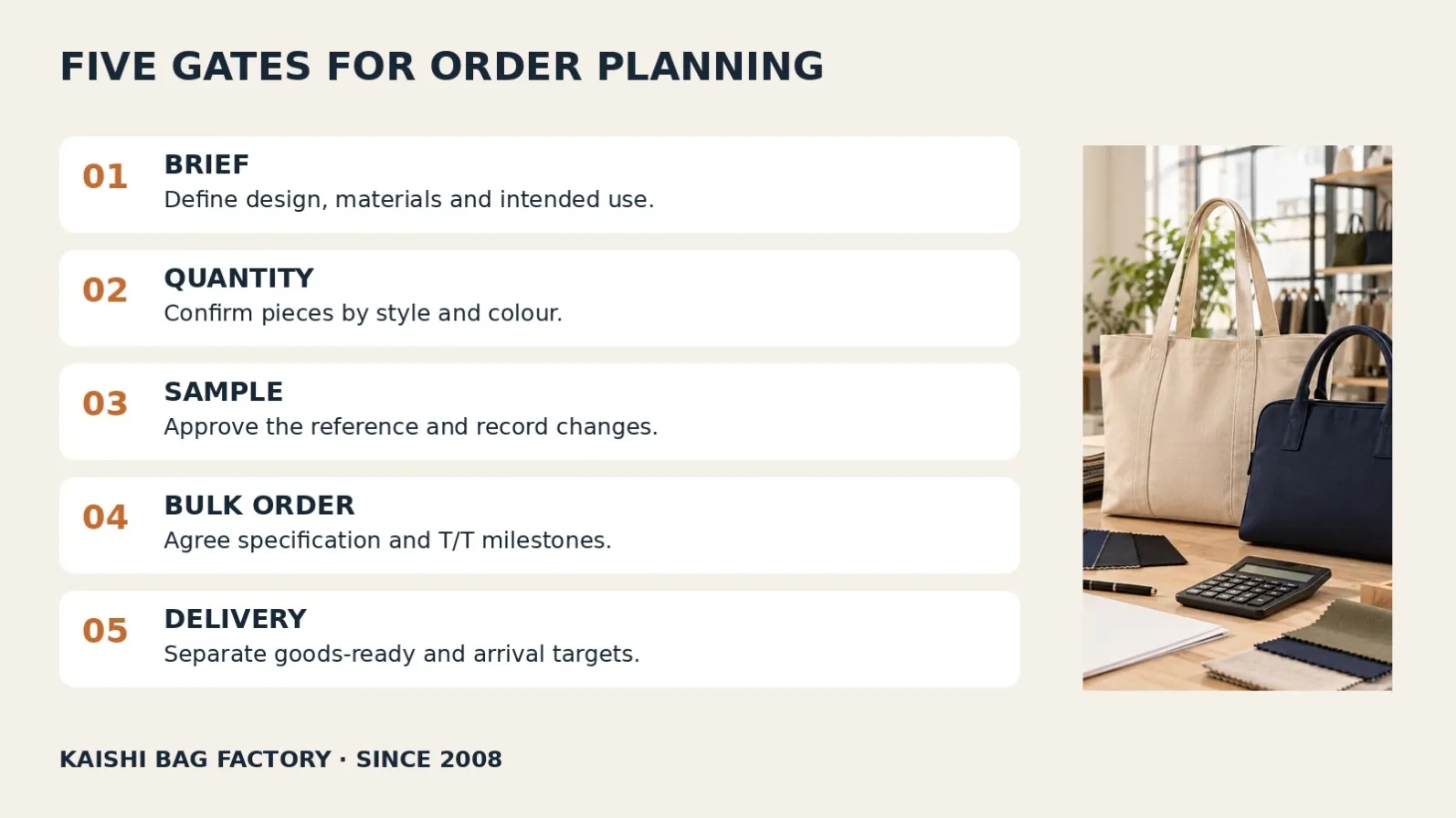
Development includes the brief, sourcing assessment, sample work and feedback. Production follows agreed commercial and technical approvals. Delivery includes collection, export handling, main transport, import clearance and final movement to your warehouse. Ask for each part separately and confirm whether an estimate ends at factory readiness or warehouse receipt.
Do not simply add several unqualified numbers and label the result a guaranteed arrival date. Some work may overlap, while missing approvals can stop progress. Identify who supplies each input and how quickly your own team can review it. A factory estimate cannot remove a buyer's artwork or sample-approval dependency.
Custom hardware, special materials, specification changes, inspection findings and freight arrangements can affect the plan. None has a universal delay duration. The practical response is to record the assumption, owner and next review date, then update the plan when evidence changes.
Build a launch plan with approval gates
- Define the warehouse arrival requirement and commercial launch date separately.
- Ask the logistics provider for route-specific delivery assumptions.
- Confirm the goods-ready target with Donna for the approved specification.
- Allow for sample review, corrections and final approval.
- Record the last date for artwork, colour and packing decisions.
If the proposed timeline does not fit, review the launch scope or date before approving bulk production. Removing checks can leave a bag that arrives on time but fails your intended use. A smaller first assortment may simplify your buyer-side decisions, but it does not automatically create a lower factory MOQ or shorter production time.
Keep a short change log after approval: what changed, who authorized it, the new version and any agreed price or schedule impact. Avoid sending a new logo or pocket layout as an informal message while expecting the previous sample and timetable to remain authoritative.
Approve quality requirements before confirming bulk
Define what the sample and inspection should check for your intended use: dimensions, component function, seams, appearance, branding and packing. Where a performance or compliance test is needed, agree the method, material version and acceptance requirement. A photograph is useful evidence for visible details but does not prove every physical or chemical property.
ISO distinguishes management-system certification from product certification. A supplier's quality-system certificate, if provided and verified, does not by itself establish that a particular bag passed your required tests. This is general buyer guidance; it is not a claim that Kaishi holds an unconfirmed certificate.
Frequently asked questions
Is Kaishi's MOQ 300 pieces for the whole order?
The standard minimum is usually 300 pieces per style. Confirm quantities by style and colour; do not assume unrelated designs can be combined.
Can my first order be 200 pieces?
It may be evaluated individually, but approval is not guaranteed. Send the actual specification and quantity breakdown to Donna.
Can I order 100 custom bags?
That quantity is generally not feasible. Discuss a realistic scope before spending on development.
Are sample fees credited to bulk production?
No automatic credit is promised. Samples are paid upfront and non-refundable; confirm charges and scope before work begins.
How long do sampling and bulk production take?
They depend on the design, materials, sample confirmation and quantity. Request a project-specific estimate with its start conditions.
Does a repeat order automatically have a lower MOQ?
No. Reconfirm the current specification, material availability and quantity requirements for each order.
What payment terms should I plan for?
T/T only, normally 50% deposit and 50% before shipment. The confirmed written order records the project milestones.
Sources and your next step
Kaishi-specific policies above come from the company's confirmed instructions. For general context, see ISO's explanation of certification and the International Trade Administration's payment-method overview. Those sources do not establish Kaishi's MOQ or offer alternative Kaishi payment options.
Send your drawing, material preferences, colour quantities, branding and target arrival window through the Kaishi contact page. Email donna@Kaishibagfactory.com or use WhatsApp to request a project assessment. Donna can confirm feasibility and the next approval step before you commit to the order.