
Sep 14, 2026Sourcing & Importing
How to Choose a Custom Bag Manufacturer in China: MOQ, Sampling, QC and Lead Times
A practical buyer's guide to choosing a custom bag manufacturer in China — MOQ, sampling, tech packs, AQL inspection, lead times, and red flags to avoid.
For most brand owners, importers and promotional buyers, choosing a custom bag manufacturer in China is not one decision but several: which factory, at what order quantity, with which materials, under what inspection plan, and on what timeline. Get them right and the supply chain works for you; get them wrong and you pay in rework, delays and unsellable stock. This guide covers what actually moves cost, quality and lead time.
Why manufacturing in China is a processing choice (not a quality verdict)
Country of origin tells you where a bag is assembled, not how well it is made. Two factories in the same city can produce very different products from the same drawing, because quality is set by the material spec, the construction details, the sample you approve and the inspection you enforce.
China's advantage for bags is supply-chain depth. Baigou, in Hebei Province, is a long-established bag cluster, where fabric mills, hardware suppliers and assembly lines sit close enough to make sampling and small-batch runs practical. At Kaishi Bag Factory, we have manufactured custom bags there since 2008, running OEM and ODM programs for brands, importers, wholesalers and promotional buyers.
The 5 things that actually determine your unit cost
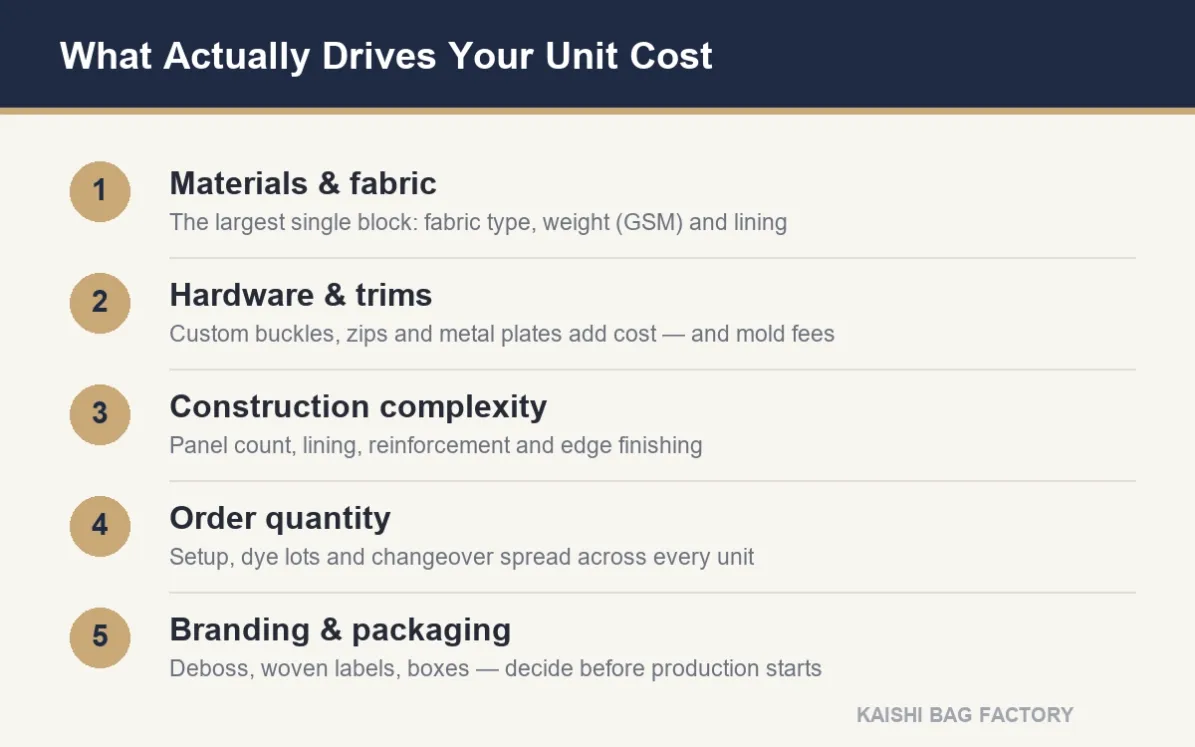
Unit price is the sum of a few real drivers. When a quote moves, one of these moved.
- Materials and trim. Fabric type, weight (GSM), composition, lining and hardware. A heavier canvas or branded zipper changes cost more than a small labor adjustment.
- Construction and labor time. Panel count, pockets, dividers, reinforcement and edge finishing. Labor is time-based, so complexity is the cost.
- Order quantity. Setup, print screens, dye lots and changeover spread across units. Higher volume lowers per-unit overhead, up to a point.
- Decoration and branding. Screen print, embroidery, heat transfer, woven labels and metal plates. Screens and plates are one-time charges; color count drives them.
- Packaging and delivery terms. Polybag or retail-ready packing, hangtags, carton spec and the Incoterm (EXW, FOB, CIF or DDP). FOB excludes freight; DDP includes it.
Ask any custom bag manufacturer in China to break a quote into material, labor, decoration, packaging and freight. A quote you can audit is one you can negotiate.
MOQ — what it really depends on and how to lower it
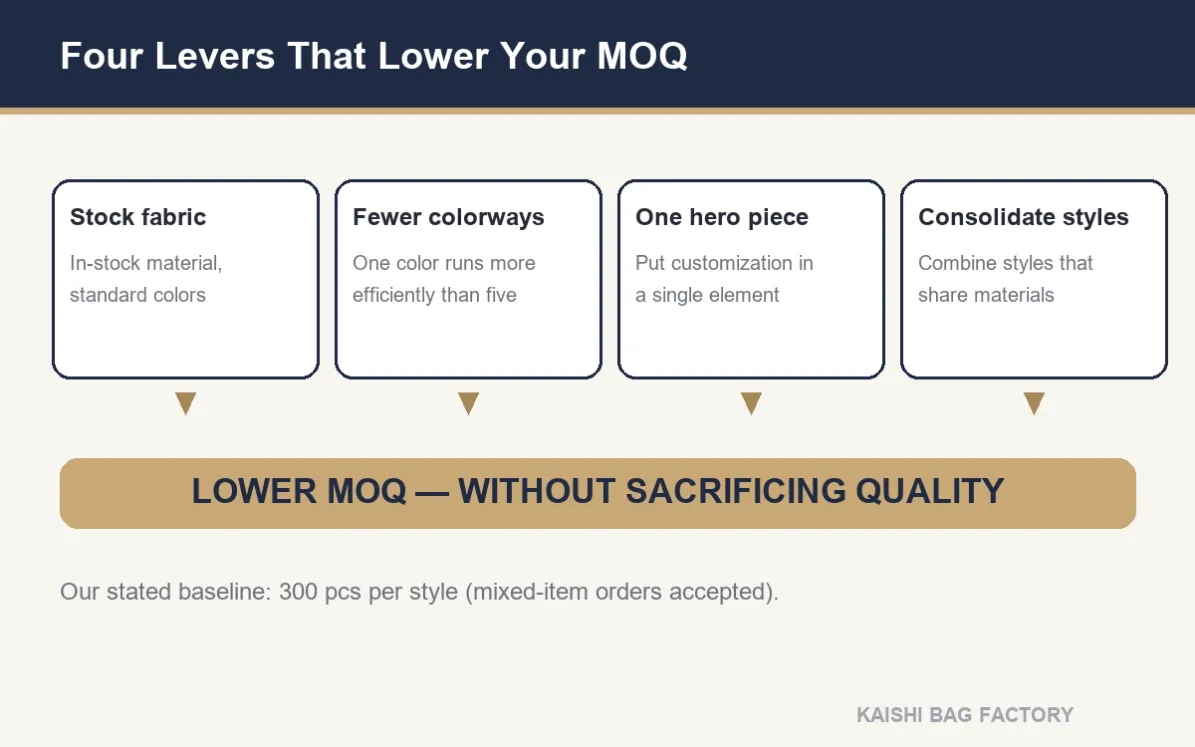
MOQ is not a number a factory picks at random. It is the smallest run that keeps a specific set of materials and setups economic. The drivers:
- Fabric minimums. Custom-dyed or custom-woven fabric usually carries a mill minimum per color; stock fabric has a lower floor.
- Decoration setup. Each screen, plate or embroidery file is a one-time cost.
- Hardware minimums. Custom pulls, buckles or engraved hardware often carry their own minimum.
- Line changeover and QC overhead, amortized across the run.
How to lower it:
- Start from stock fabric and standard colors; save custom dye for proven styles.
- Reuse one hardware family across styles.
- Combine styles that share fabric, lining and hardware into one purchase order.
- Differentiate variants with trim — a woven label or hangtag — not a new body.
- Give a forecast and agree a phased release, or ask the MOQ for stock versus custom.
Because MOQ reflects real costs, it is negotiable — especially when you remove the setup that caused it.
Sampling and the tech pack: what to send us so the first sample is close
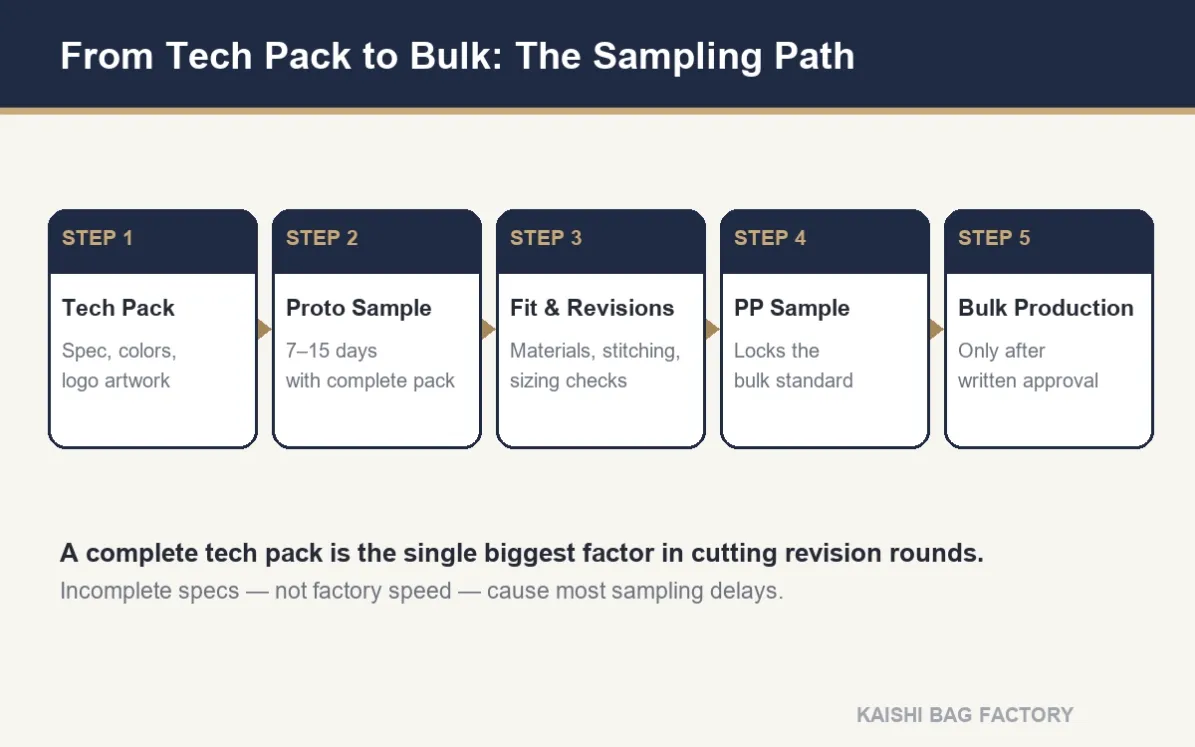
Sampling is where a design becomes a measurable product, and a complete tech pack keeps revision rounds down. Include:
- Dimensions and tolerances — finished length, width and depth, plus seam allowance.
- Material spec — fabric type, composition, weight (GSM), color reference (Pantone TCX), lining and interfacing.
- Construction — panel layout, edge treatment, reinforcement at stress points, stitch type and density (SPI).
- Hardware — zipper type and length, slider and puller, buckles, D-rings and feet, with base metal and finish.
- Branding — a vector logo file with size, position, method and thread colors.
- Labeling and packaging requirements.
Photos help; a physical reference bag is better, because a sample you want matched removes more guesswork than any description.
Sampling usually runs through a proto sample for proportion, a fit sample for materials and construction, then a pre-production (PP) sample that locks the bulk standard. Revision rounds depend on design complexity and how complete your brief is — the more specification you confirm before sampling, the fewer rounds you need.
Materials and trim choices for bags (canvas, PU/vegan leather, suede, woven, hardware)
What you specify drives cost, durability and how the bag is perceived.
- Canvas. Cotton and poly-cotton, usually specified by weight (roughly 8 oz to 16 oz and up). Durable and print-friendly; common for totes. See our canvas tote bag manufacturing.
- PU / vegan leather. A coated fabric — polyurethane on a knit or woven backing. "Vegan leather" is a marketing term for PU and similar materials. Easy to clean and holds structure; common for fashion totes and crossbody bags. See vegan leather tote bag manufacturing.
- Suede. Genuine or microfiber suede, chosen for texture and hand-feel, but more care-sensitive.
- Woven. PP (polypropylene) woven for heavy-duty and promotional use. Water-resistant and cost-effective at volume.
- Hardware and trim. Base metal, plating finish, zipper type (nylon coil, metal or molded plastic), pulls, buckles, D-rings, feet, piping, webbing and lining. Specify base metal, finish and function, not appearance alone.
Ask for material spec sheets rather than judging from photos. For the full range we build, see our custom bag products.
Quality control — your AQL inspection plan
Quality control on a bag order is a plan, not a promise. The industry standard is AQL sampling under ISO 2859-1 (equivalent to ANSI/ASQ Z1.4): you agree defect classes and limits, then inspect a random sample from the finished lot instead of every piece.
Lot size determines sample size, and the plan gives an accept (Ac) and reject (Re) number. Consumer-goods inspections commonly run critical defects at 0, major around 2.5 and minor around 4.0 — confirm levels with your buyer or QA team. Defects are classed as critical (safety or function), major (a visible defect affecting sale) and minor (cosmetic issues within tolerance).
Inspect in stages: incoming material, in-line checks during production, and pre-shipment final inspection before packing. Check dimensions against spec, stitch density, color against the approved swatch, hardware function, logo placement and packing. The pre-production sample is the reference; put the inspection plan and who pays for it in the purchase order.
Lead time and shipping: from PO to port
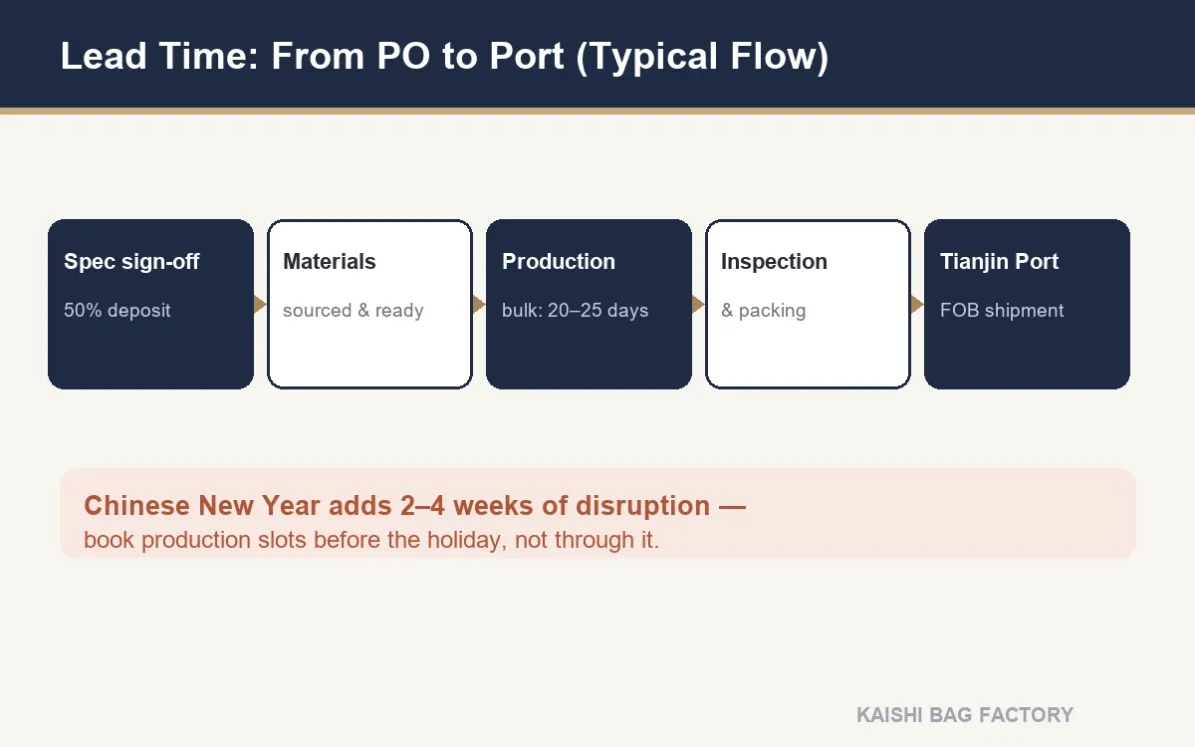
Lead time is not one number. It runs from purchase order to port and stacks several stages:
- Order confirmation, deposit and spec sign-off.
- Material procurement — fast for stock fabric, longer for custom dyeing or weaving.
- Pre-production sample approval, which must clear before bulk starts.
- Bulk production, which scales with quantity and complexity.
- In-line and final inspection, then packing.
- Booking, inland transport to port, export clearance, then ocean or air freight.
Because lead time depends on quantity, material availability, decoration and factory load — and stretches before major holidays — a responsible factory quotes a range and explains what would compress or extend it.
Agree the Incoterm in writing: EXW, FOB, CIF or DDP. From the Baigou area, FOB shipments typically move through Tianjin, though Ningbo, Shanghai and Shenzhen are also used depending on route and carrier. Air freight suits urgent, low-volume runs; sea freight suits bulk.
Red flags when vetting a custom bag manufacturer in China
Most sourcing problems are visible before the deposit if you look for them:
- No verifiable business license, or a quote under one company name and payment requested to another account.
- Refusal of a live video walkthrough or a factory visit.
- The same MOQ quoted for very different products, or no explanation of what drives MOQ.
- Skipping the pre-production sample and moving straight to bulk.
- Refusing third-party inspection or declining to share a prior inspection report.
- No material spec sheets, color references or hardware details in the quotation.
- Pressure to pay a large share upfront into a personal account rather than a traceable company account.
- Guarantees no factory can keep, such as a fixed lead time for any quantity or a zero-defect commitment.
None of these alone proves a problem. A pattern of them — or a refusal to answer — is your answer.
FAQ
What is the MOQ for custom bags?
It depends on fabric, decoration and hardware. Stock materials allow the lowest minimums; custom dye or hardware raise them. Combine styles that share materials to reach the minimum.
How long does the bag sampling process take?
It depends on design complexity and how complete your tech pack is. A simple tote may take a couple of rounds; a structured bag with custom hardware usually takes more. A complete spec shortens it.
Can I put my logo on a custom bag, and which methods work?
Yes. Common methods include screen printing, embroidery, heat transfer, woven labels, patches and metal plates. The right choice depends on the material and the look you want. Vector artwork and Pantone references help.
How do I check quality before shipment?
Use an AQL pre-shipment inspection against an approved pre-production sample, with defect limits agreed in advance. You can inspect in-house or use a third party, and should ask for photos of packed cartons.
What is the difference between OEM and ODM?
OEM means you supply the design and the factory builds to it. ODM means you adapt the factory's existing designs, then customize materials, colors and branding. ODM is often faster for a first order.
Next step
If you are ready to evaluate a custom bag program, send three things: the style and dimensions, the materials and branding you have in mind, and your target quantity and market. That is enough for a manufacturer to tell you what is realistic on MOQ, sampling and lead time — and what is not.
At Kaishi Bag Factory, we manufacture canvas, PU/vegan leather, suede, woven and other custom bags in Baigou for brands, importers, wholesalers and promotional buyers, with OEM and ODM programs. Send your spec and target quantity through our contact page, and we will reply with a quotation and a sampling plan.