
Sep 17, 2026Sourcing & Importing
GPSR Compliance for Bags Sold in the EU: A 2026 Importer Checklist
What GPSR (EU 2023/988) requires bag importers to do: the EU responsible person, label and listing data, technical files, and a pre-order checklist.
A carton of canvas totes reaches a Hamburg fulfilment centre, and the retail label carries the factory's name but no EU address for a responsible person. Under GPSR, that product cannot be placed on the EU market until the gap is closed. The fix is not complicated, but it has to be built in before the label is printed, not after the container lands.
GPSR (Regulation (EU) 2023/988) has applied since 13 December 2024, replacing the General Product Safety Directive. It covers consumer products placed on the EU market, including goods sold online. It also puts concrete duties on the importer, the economic operator who brings bags into the market. This article covers what matters for a bag program: the responsible person, the data that must travel with the product, the listing rules, the technical file, and the checklist we run with buyers.
Who carries the GPSR duty for a bag order
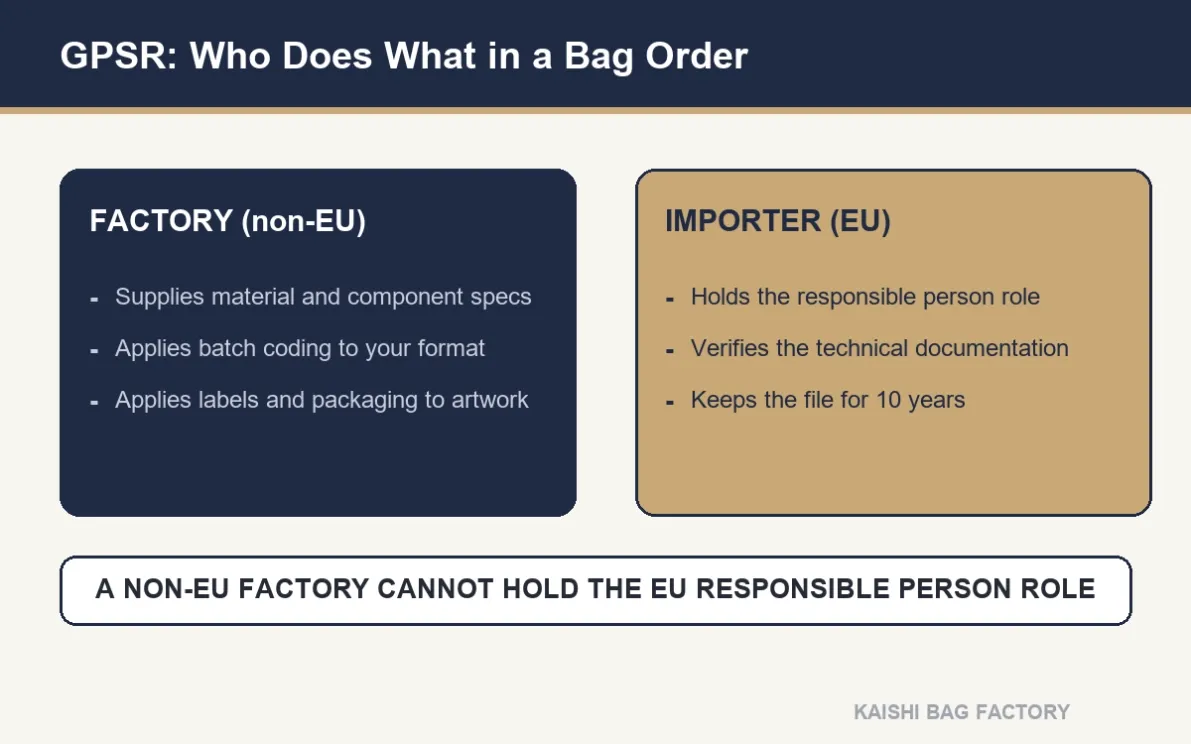
The importer. When bags are manufactured outside the EU and brought in, the importer becomes the economic operator responsible for the safety position. That is a legal role, not a paperwork preference. The duty cannot be contracted away to a Chinese factory, because the factory is not established in the EU.
Three duties land on the importer in practice:
- Verify the manufacturer's technical documentation, including the risk assessment, before placing the product on the market.
- Add your own name and contact details to the product or its packaging, under Article 11.
- Keep a copy of the technical documentation for ten years after the product is placed on the market.
If you sell through Amazon, a fulfilment provider or your own EU warehouse, one of those entities may take on parts of the compliance role. The importer of record still answers for the product.
The EU responsible person: the line that must exist first
Article 16 requires an EU-established responsible person for products from outside the EU, and without one a consumer product may not be placed on the EU market. That person can be an EU manufacturer, an importer, an authorised representative acting under written mandate, or a fulfilment service provider. Their name and contact details must accompany the product.
Don't treat the responsible person as a formality you add at the end. We have watched buyers order labels, print retail cartons and book freight, then discover nobody is named as the EU contact. Reprinting a label is cheap. Reprinting a container's worth of retail packaging while a launch date slides is not.
Two details trip up first-time importers. The responsible person must be established in the EU, not a Chinese agent with an EU phone number. And the details have to travel with the physical product, not only sit in your inbox.
What has to appear on the bag, label and packaging
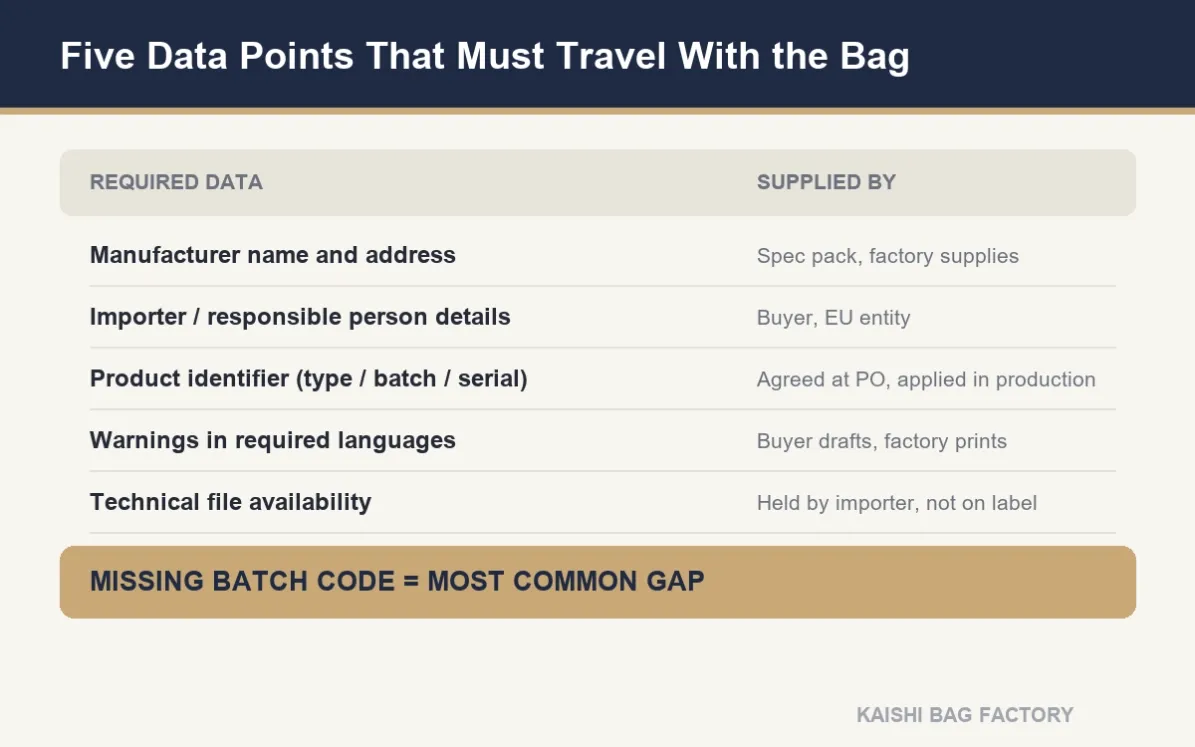
Traceability is the core requirement: a product identifier such as a batch or serial number, plus operator details. Build this into the specification before sampling, because label artwork is approved together with the sample.
- Manufacturer name and address · Where it goes: Product, label or packaging · Who supplies it: Factory, in the spec pack
- Importer or responsible person details · Where it goes: Product, label or packaging · Who supplies it: Buyer, with the EU entity
- Product identifier (type, batch, serial) · Where it goes: On the product or packaging · Who supplies it: Agreed at PO stage, applied by factory
- Warnings and safety information · Where it goes: Label, in the language(s) of the member states where sold · Who supplies it: Buyer drafts, factory prints
- Technical file availability · Where it goes: Held by the importer, not shown on the label · Who supplies it: Factory supplies the inputs
A batch code is the item most often missing from a bag spec. A woven or printed batch label added at sampling stage costs very little. Retrofitting batch coding across packed cartons after production is manual work, and it is the kind of work that delays a shipment.
Your online listing is part of the product
Article 19 sets out what the offer must show before purchase:
- the manufacturer's name and contact details
- the EU responsible person's details, where the manufacturer is outside the EU
- product identification: type, batch or serial number, plus a picture
- any warnings in the languages of the member states where it is sold
For most bag brands this means the product page needs a compliance block of its own, not a PDF buried in the footer. Marketplaces carry parallel duties. Under GPSR they must register with Safety Gate and keep a named contact point. They must also remove dangerous listings within two working days of an authority order, and process dangerous-product notices within three working days.
The technical file: what to assemble and what to keep
Article 9(2) requires an internal risk analysis and technical documentation for each product. The minimum content is a general description of the product and its essential safety characteristics, plus the risk analysis and the solutions applied to mitigate risk. Importers verify this documentation and keep a copy for ten years.
The safety assessment under Article 6 is broader than most buyers expect. It should consider packaging, how the product interacts with other products, its appearance where relevant, and cybersecurity or connected features where applicable. For a bag, the realistic risk areas are small parts and attachment strength on children's products, plus chemical restrictions in materials and coatings. Load-bearing components such as straps and hardware also matter.
Ask your factory for material and component inputs early. Assembling a technical file retroactively, across three suppliers and two seasons, is slow and expensive.
What we provide as the factory, and what stays with you
The factory supplies inputs. The importer owns the compliance position. In practice, for canvas tote programs or vegan leather totes we hand buyers:
- material and component specifications for the file: fabric, lining, zipper type, hardware base metal
- batch coding applied at production, in whatever format the buyer specifies
- label and packaging application to the buyer's approved artwork
- consistency between the approved sample and bulk, which is what the production record should reflect
What stays with the buyer: the risk assessment, the EU responsible person arrangement, the listing text, and the ten-year file. Our default specifications are the raw material for your risk file. Canvas runs 12 to 16 oz, PU roughly 1.2 mm, linings in 210 polyester or cotton, zippers in nylon, metal or resin, and hardware in zinc alloy. That level of detail is why we send a spec sheet rather than a photo. Ask for it even from a supplier you are only testing.
A pre-order GPSR checklist for bag buyers
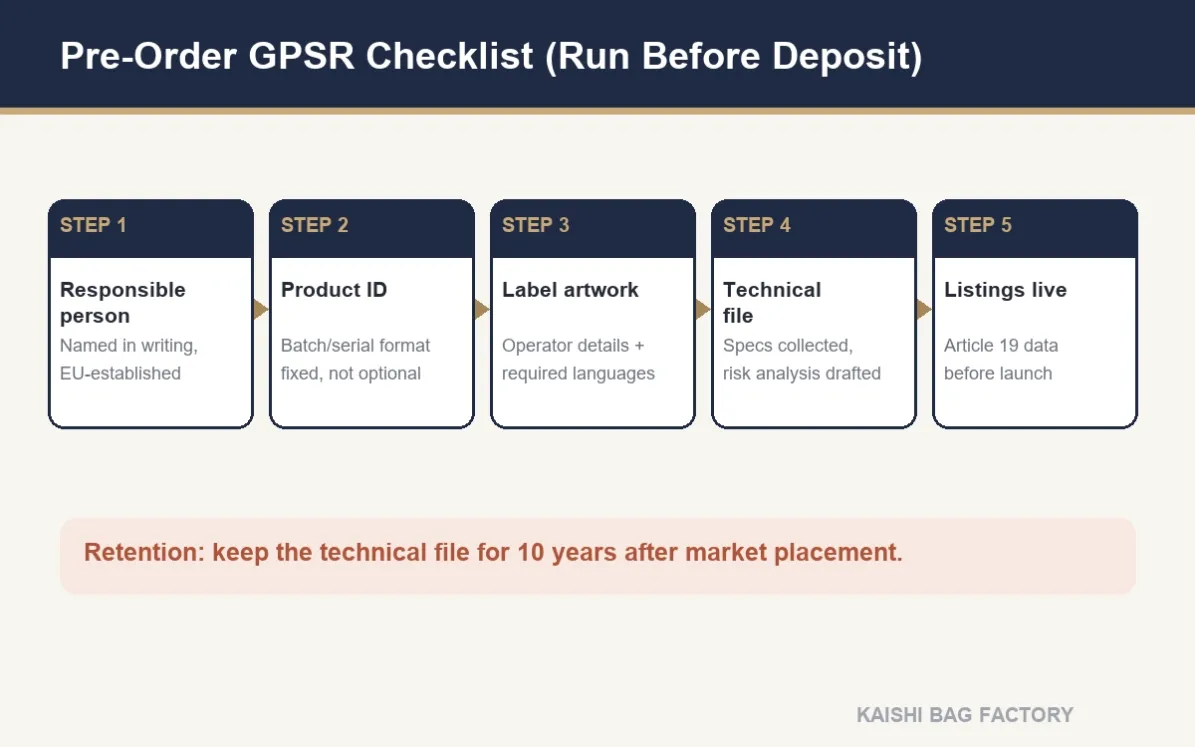
Run this before the deposit, not before shipping:
- Confirm who the EU responsible person will be, and get their name and address in writing.
- Decide the product identifier format, batch or serial, and specify where it is applied.
- Confirm the label and packaging artwork carries manufacturer and importer or responsible person details, in the required languages.
- Collect material and component specifications from the factory for the technical file.
- Draft the risk analysis and record the mitigations actually applied.
- Update every online listing with the Article 19 data before the product goes live.
- Assign a named owner and set the ten-year retention for the technical file.
Our standard terms support this timing. The baseline is 300 pieces per style for most programs, with mixed-item orders accepted. Sampling runs 7 to 15 days with a complete tech pack, and bulk production 20 to 25 days once materials are in house. Ordering earlier costs less than repairing a compliance gap in a warehouse.
FAQ
Does GPSR apply to bags sold on Amazon in the EU?
Yes. GPSR covers consumer products sold online. Article 19 requires the listing itself to carry manufacturer details, the EU responsible person where applicable, product identifiers and warnings in the relevant languages.
Who can act as the EU responsible person for a bag brand outside the EU?
An EU-established manufacturer, importer, authorised representative acting under written mandate, or fulfilment service provider. Their name and contact details must accompany the product.
What must appear on a bag label under GPSR?
Four items: manufacturer details; the importer or responsible person's name and contact details; a product identifier such as a batch or serial number; and any required warnings in the languages of the member states where the product is sold.
How long must importers keep GPSR technical documentation?
Ten years after the product is placed on the market. The file should include the product description, its essential safety characteristics, the risk analysis and the mitigations applied.
Can the Chinese factory take on GPSR compliance for us?
No. A factory outside the EU cannot hold the EU responsible person role. It can supply specifications, batch coding and label application, but the importer verifies and retains the documentation and holds the market position.
Next step
Before you approve label artwork, name the EU responsible person, fix the product identifier format, and request the material specs for your technical file. Three decisions, made at sampling stage, remove most of the GPSR delay risk from a bag program.
At Kaishi Bag Factory we produce canvas, PU and vegan leather totes, hobo bags and 3-piece sets in Baigou. We supply the specification and batch-detail inputs your EU file needs. Send your spec and destination market through our contact page, and we will quote with the material detail your compliance file requires. You can also see product examples here.