
Custom Travel and Sports Bags: What Buyers Should Know
A B2B specification guide for custom travel and sports bags: materials, load paths, zippers, moisture claims, testing, MOQ and sample approval process.
Quick answer
A reliable custom travel or sports bag begins with the use case, expected load and test plan—not with a fabric name alone. Buyers should specify bag dimensions, intended contents, carrying method, reinforcement, compartment functions, zipper and hardware requirements, packing and destination-market compliance. Performance claims such as “waterproof,” “heavy duty” or “odor resistant” need an agreed definition and evidence.
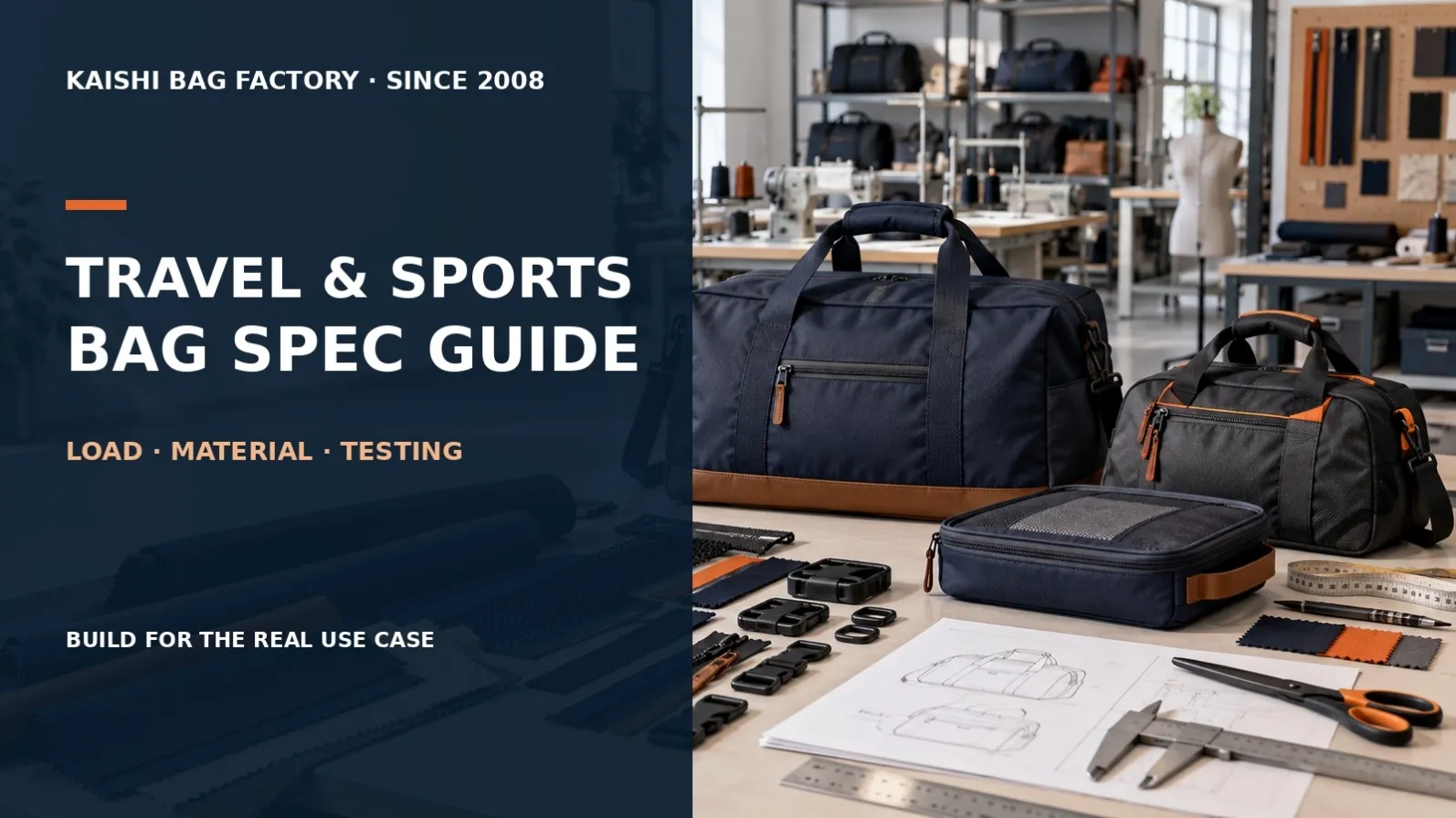
Kaishi Bag Factory is based in Baigou, China and has developed OEM/ODM bags since 2008. Standard MOQ is usually 300 pieces per style. A 200-piece first order may be evaluated case by case and is not guaranteed; 100 pieces is usually not workable. Material availability, sample approval and quantity determine the quotation and schedule.
Six decisions before requesting a quote
- Define the user, trip or sport and the contents carried.
- Set the finished size, target load and carrying modes.
- Map load paths from handles and straps into the body.
- Specify each compartment and its lining separately.
- Choose measurable material and component requirements.
- Agree the sample, performance checks and inspection plan.
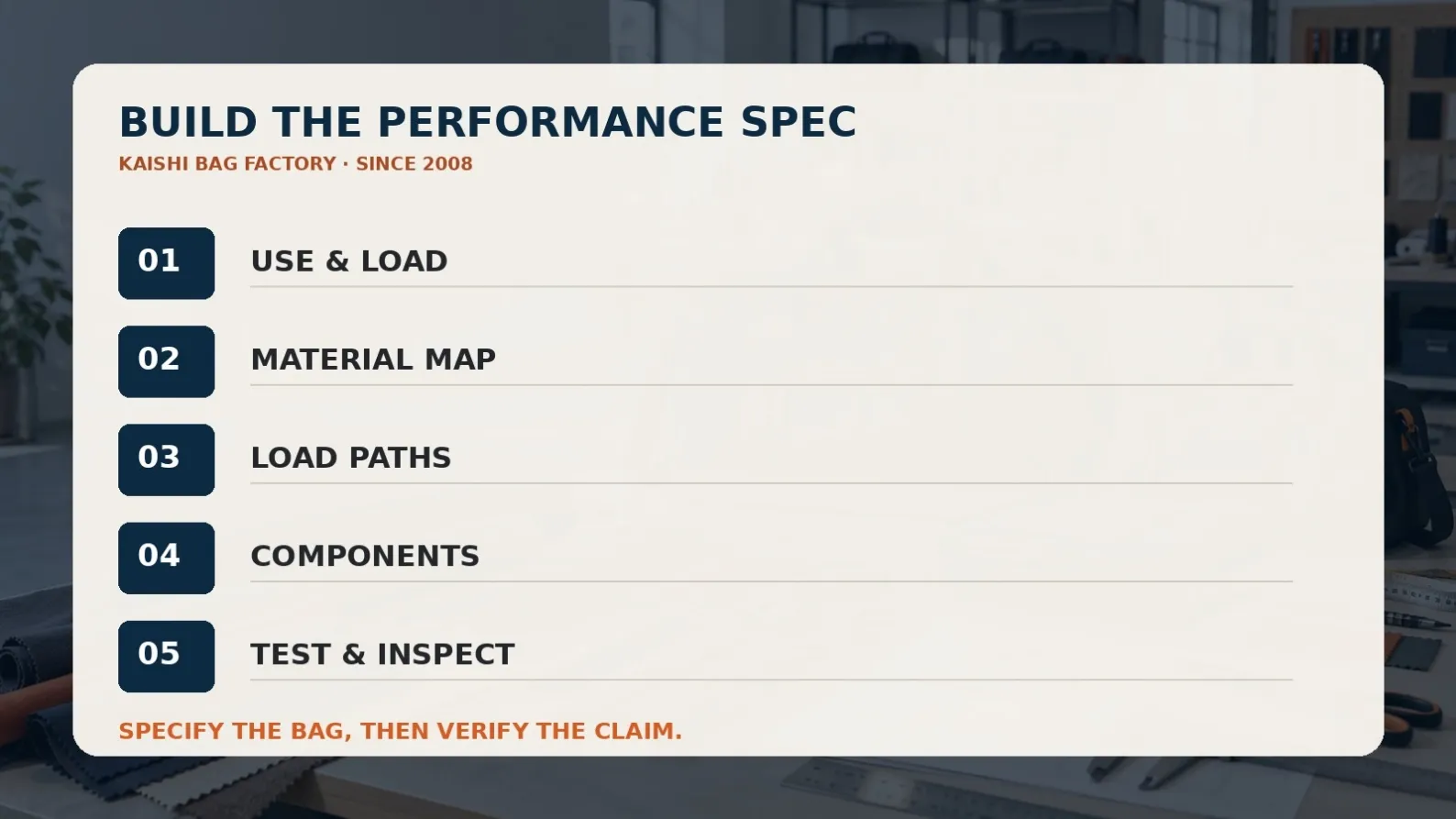
Match construction, components and verification to the bag’s actual use.
1. Separate the product types
“Travel and sports bags” covers products with different priorities. A weekender emphasizes volume, appearance and hand or shoulder carrying. A gym bag may need shoe separation, ventilation and easy-clean surfaces. Packing organizers prioritize low weight and repeated zipper use. Sport-specific bags may require shaped compartments or attachment systems.
- Duffel or weekender: define how the loaded weight transfers into the body; check handle and shoulder-strap attachments.
- Gym bag: define how damp items or shoes are separated; check moisture migration and cleanability.
- Travel organizer: define expected zipper and mesh cycling; check zipper, seam and mesh durability.
- Sport-specific carrier: define equipment dimensions and retention; check fit and carrying stability.
2. Specify materials by construction and performance
Nylon and polyester are broad fiber families, not complete specifications. The finished behavior also depends on yarn, weave, fabric mass, backing or coating, finish and supplier consistency. A denier number describes yarn linear density; it does not by itself prove abrasion resistance, tear strength or water resistance.
Canvas can suit heritage-style travel bags, but its weight and absorbency differ from coated synthetics. Mesh can provide ventilation, yet aperture, yarn and seam support affect durability. Ask for a physical swatch and sample, record the approved reference and identify which panels use each material.
A practical material schedule
- Outer shell and base
- Main lining and pocket linings
- Mesh or ventilation panels
- Foam, board and reinforcement layers
- Webbing width, structure and color
- Zipper tape, chain, slider and puller
- Buckles, hooks, rings and adjusters
3. Engineer the load paths
Handles and shoulder straps should not terminate on an unsupported shell panel. The factory must define how webbing, reinforcement patches, seams and panel structure distribute the load. Appropriate solutions vary by material and design; bar tacks, box-and-cross stitching or extended webbing are options, not universal rules.
The base may need a different material or reinforcement because it meets floors and carries the contents. Protective feet are useful only when their attachment and surrounding structure are suitable. A feature should be justified by the use case rather than added as decoration.
4. Define zippers, hardware and access
Do not prescribe one zipper size for every travel bag. Select zipper type and chain size according to opening length, curvature, loading, intended life and appearance. During sampling, check smooth operation along the complete opening, slider retention, end stops, alignment and behavior when the bag is filled.
Hardware should be specified by function, dimensions, base material, finish and approved reference. Check that hooks rotate or lock as intended, adjusters hold the webbing and metal edges do not abrade it. Salt, sweat or wet-use environments may require additional corrosion evaluation agreed for that product.
5. Treat moisture claims carefully
A coated fabric can resist water while stitched seams, zipper openings or construction details still allow ingress. “Water-resistant” and “waterproof” should therefore not be used interchangeably. Define the exposure scenario, test method, duration and acceptable result before making a claim.
A wet pocket also needs a cleaning and drying strategy. Coated lining, seam construction, drainage, ventilation and user instructions can all matter. Avoid claiming that a compartment is fully waterproof unless the complete construction has been validated for that claim.
6. Build a product-specific test plan
Testing should reflect how the bag will be used. International and industry standards provide methods for evaluating textile properties, but the buyer must select suitable methods and acceptance criteria for the finished product. A material test alone does not prove the assembled bag will perform.
- Fabric wear: use an agreed abrasion or surface-damage method for panels that face repeated contact.
- Seam or attachment failure: use a defined static-load or repeated-lifting protocol based on a realistic packed load.
- Zipper failure: check operation and cycling under defined loading and tension.
- Water ingress: agree a spray or exposure procedure and identify which areas must remain dry.
- Color or finish change: select relevant rubbing, sweat or corrosion checks for the expected conditions.
ISO publishes international standards for textile testing, including methods related to tensile and abrasion properties. Use the current edition specified by the buyer or testing laboratory, and record the method, specimen and result rather than stating “tested” without context.
7. Control sampling and bulk production
Provide a tech pack with dimensions, tolerances, material placement, reinforcement, components, artwork, packaging and intended load. Samples are paid in advance and are not automatically refundable. Sample cost, shipping and timing are confirmed before development; changes after work begins can require a revised quotation or another sample.
Before bulk production, approve the finished sample and a written specification. During inspection, check measurements, workmanship, function, load-critical areas, logo, labeling, quantities and packing. The acceptance plan should identify defect categories and the agreed sampling approach.
Commercial terms at Kaishi
- Standard MOQ is usually 300 pieces per style.
- A 200-piece first order may be evaluated case by case; it is not guaranteed.
- 100 pieces is usually not workable for custom production.
- Payment is by T/T only, usually 50% deposit and 50% before shipment.
- Lead time is confirmed after design, materials, sample approval and quantity are clear.
- Different colors or styles cannot be assumed to share one MOQ.
Frequently asked questions
Is nylon always stronger than polyester?
No. Fiber type alone does not determine finished performance. Compare the actual fabric construction, finish and relevant test results.
What denier should I use for a duffel bag?
There is no universal answer. Choose after considering load, panel position, weight target, coating, appearance and test requirements.
Does coated fabric make the whole bag waterproof?
No. Seams, zippers and construction can still allow ingress. Validate the finished bag against a defined exposure requirement.
What is Kaishi’s MOQ?
Standard MOQ is usually 300 pieces per style. A 200-piece first order may be evaluated case by case; 100 pieces is usually not workable.
Are samples free?
No blanket free-sample policy applies. Sample and shipping costs are paid in advance and confirmed before development.
How long will sampling and production take?
Timing depends on design readiness, materials, tooling, artwork, revisions, sample approval and quantity. It is confirmed project by project.
What should I send for a quotation?
Send dimensions, intended use and load, quantity by color, materials, compartments, components, artwork, packing, destination and required tests.
Sources and further reading
- ISO: International standards overview
- ISO 13934-1: Tensile properties of fabrics
- ISO 12947-2: Abrasion resistance of fabrics
Request a travel or sports bag review
Send your tech pack, reference, intended use, load, quantity, target market and test expectations. Kaishi Bag Factory will review what can be developed, sampled and quoted.