Oct 4, 2026Sourcing & Importing
Custom Tote Bag MOQ: What Drives It and 5 Ways to Lower It
What actually drives custom tote bag MOQ, and five practical ways to lower it without wrecking your unit price. Factory-side numbers, no fluff.
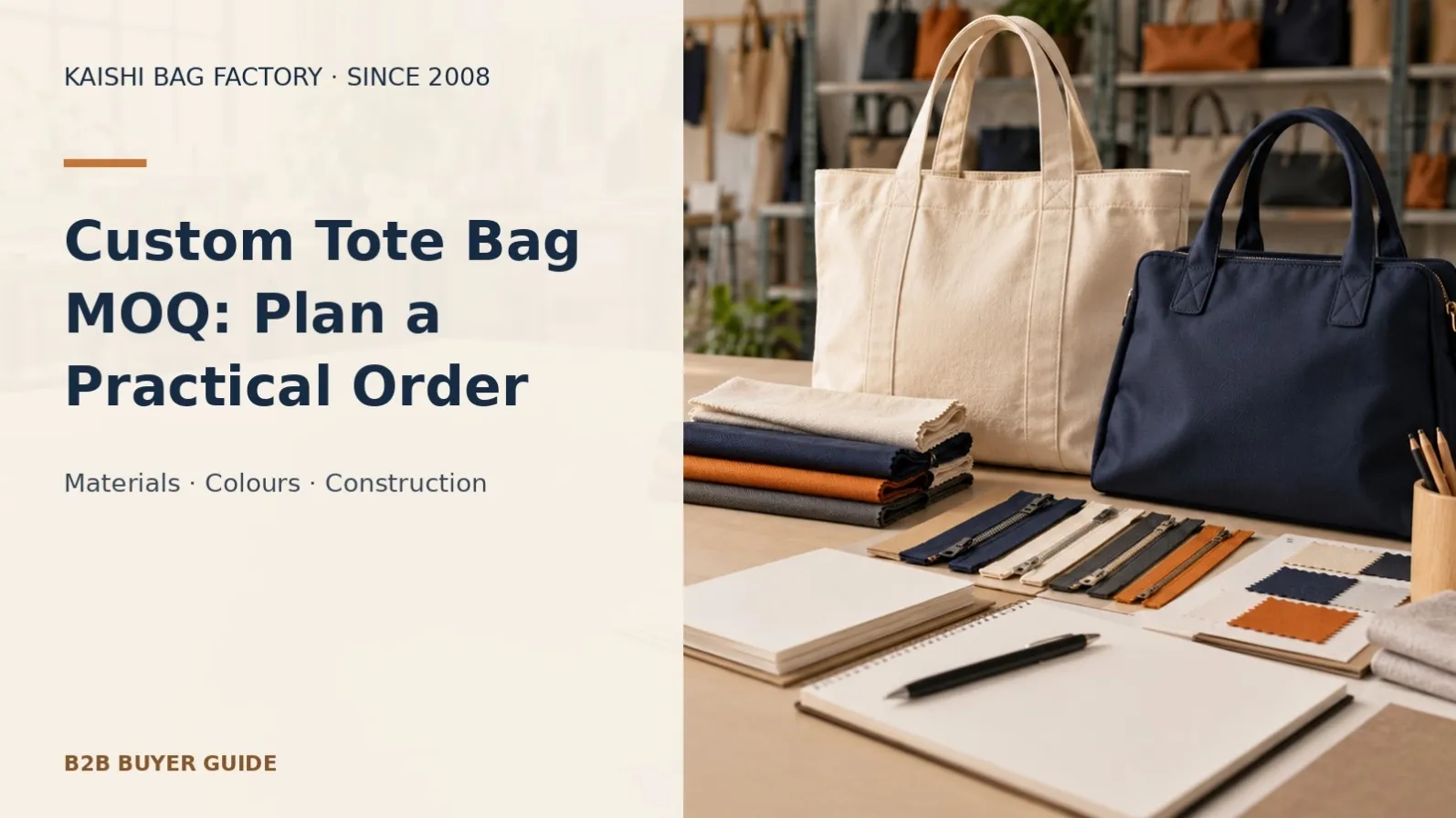
Quick answer: A custom tote bag MOQ is the smallest run that keeps your exact fabric, colours and hardware economic, so it is a sum, not a policy. Four cost blocks set it: mill fabric minimums, branding setup, custom hardware tooling and line changeover. Five levers lower it, and our baseline for tote programs sits at 300 pieces per style with mixed orders accepted.
An inquiry arrives with a tight brief: 200 tote bags, custom-dyed navy, debossed logo, engraved zipper pulls. We price it honestly and the unit cost lands near double the buyer's target. The buyer asks whether we can simply run 200. We can. It will not be the same bag at the same price, and that gap is worth understanding before you send your own inquiry.
Why an MOQ is arithmetic, not a policy
A factory that quotes a minimum order quantity has added up four costs and divided them by your run size. Below that size the math stops working, and one of two things happens. Your unit price climbs past what your market can carry, or the factory quietly drops to cheaper fabric and hardware to hit your target price. The second outcome is more common, and it costs you a season.
That is why two suppliers can quote 500 and 300 for the same brief. The difference is rarely kindness. It is which materials each one plans to use at that volume.
Four cost blocks that set your MOQ
Every minimum we quote is the sum of these four. Pull one block out and the number drops.
Fabric and dye minimums. Stock cloth can be cut from what already sits on the shelf. A custom shade means the mill dyes your colour alone, and mills typically sell dye lots by length rather than by the bag. This block moves your MOQ more than anything else on the list.
Branding setup. Every screen, plate or die is a one-time cost, charged per colour. A three-colour print means three setups spread across your run, so small runs carry them hard.
Custom hardware. A moulded buckle or an engraved zipper pull needs a tool. That tool cost lands either on your first order or spread across a bigger one. Stock hardware carries neither.
Line changeover and checks. Setting up a sewing line for one style costs the same whether you then run 200 pieces or 2,000. Below a workable run, that fixed cost per bag climbs quickly.
Our baseline for tote programs is 300 pieces per style, with mixed orders accepted across styles that share materials. On our floor, that number comes straight from the four blocks above.
Five levers that lower it
Every lever works the same way: it removes the cost block that pushed your minimum up. None of them is magic, and each one trades something away. We will not quote a 250-piece run on custom-dyed cloth at the same unit price as a 1,000-piece run. A factory that does is planning a material swap you will meet at the sample stage, or later at the port.
Start from stock fabric and standard colours. Save the custom dye for a style you have already sold. A first order in a stock navy can run at our baseline; the same bag in your own Pantone shade pushes the number up.
Cut the colourway count. One colour at 600 pieces is easier on the line than three colours at 200 each. When the range needs variety, put it in the trim: a woven label, a hangtag, a different pull.
Keep one hero detail. Concentrate your custom element instead of scattering it. A custom pull on an otherwise stock bag stays near baseline. A custom pull, custom buckle, custom rivets and custom lining together are a different program at a higher minimum.
Combine styles onto one order. Styles that share fabric, lining and hardware can share a run and reach the minimum together. This is where mixed orders earn their keep, and it is the fastest route for a range rather than a single bag.
Give a forecast and take a phased release. Tell the factory what the year looks like and split the buy: a smaller first batch now, more later. Factories price risk, and a plan lowers it.
What each lever costs you
Nothing on that list is free. Every lever moves cost somewhere.
Stock fabric · What it saves: Mill minimums, weeks of lead time · What it costs: Exclusivity: another brand can buy the same cloth
Fewer colourways · What it saves: Setup and changeover per run · What it costs: Range depth at launch
One hero detail · What it saves: Tooling and unit cost · What it costs: Less visual distance from stock styles
Combined styles · What it saves: Reaching the minimum without dead stock · What it costs: One late style holds the whole order
Phased release · What it saves: Cash tied up in stock · What it costs: A step more per unit on the first batch
Which lever you pull first depends on your case.
Brand founder, starting a new brand: stock fabric plus one hero detail. Lowest risk, fastest sample, and the trim still carries your brand identity.
Promotional buyer with a fixed date: combined styles in stock colours. The schedule beats exclusivity when the event date cannot move.
Amazon seller testing a style: a phased release. Plan the timing around the Chinese New Year calendar. Prove the bag sells before you commit to the big run.
Wholesaler refreshing a range: fewer colourways, more depth per colour. Reorders stay simple and the line stays clean.
FAQ
What is the MOQ for custom tote bags?
It depends on your fabric, colour and trim, so no single number covers every program. Our baseline is 300 pieces per style with mixed orders accepted, and custom dye or custom hardware raises it.
Can I order fewer than 300 pieces?
Yes, with trade-offs. Below the baseline the usual routes are stock materials, standard colours and a higher unit price that reflects the setup. A lower minimum at the lowest unit price is not a realistic combination.
Does MOQ drop on repeat orders?
Usually yes, because setup costs are already paid. Screens, plates and tools exist after the first run, so a reorder in the same colour and hardware often starts lower.
Is a lower MOQ always cheaper overall?
No. A smaller run usually carries a higher unit price, so compare total landed cost rather than the minimum itself. Paying a step more per bag can still beat holding a year of stock.
How do mixed orders work?
Mixed orders combine styles that share fabric, lining and hardware into one run so they reach the minimum together. Custom colours or custom hardware on one style break that sharing, and the minimum climbs again.
Next step
Before you ask for a lower minimum, decide which lever you can live with: stock fabric, fewer colours, fewer custom elements, combined styles, or a phased buy. Then put your style, target quantity and destination market into one message. Send it through our contact page and we will quote your baseline with the trade-offs written out.
At Kaishi Bag Factory we make totes, shoulder bags and 3-piece sets in Baigou, from stock canvas at 12 to 16 ounces to custom tote programs and canvas totes. You can also browse product examples before you write.